
How to Provide a Private Island with Drinking Water: A Practical Guide
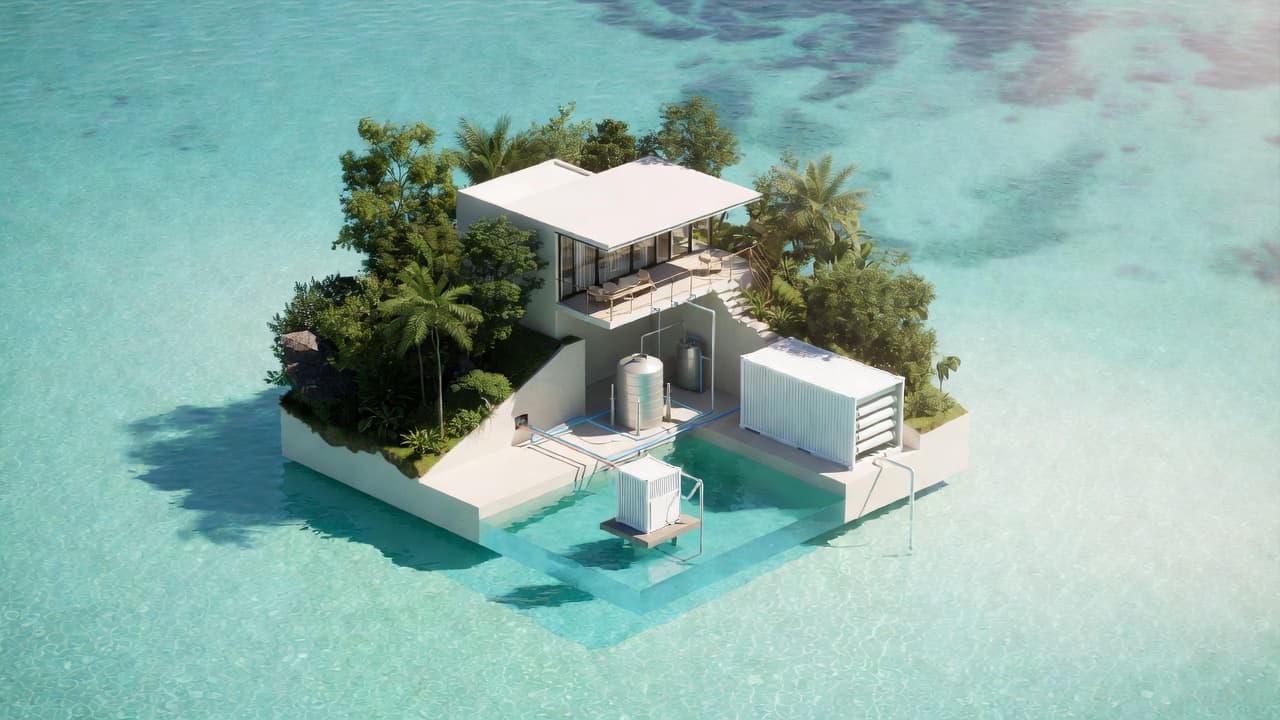
Table of contents
- Why Freshwater Supply Is the First Challenge for Private Islands
- Assess Your Island’s Needs and Constraints
- Calculate Your Daily Water Demand
- Document Island Geography and Constraints
- Gather Climate and Rainfall Data
- Assess Energy Availability and Cost
- Inventory Existing Infrastructure
- Define Budget and Planning Horizon
- Decision Tree: Choosing Your Primary Water Supply Method
- Checklist: Pre-Implementation Site Assessment
- Desalination (Reverse Osmosis): Sizing, Energy, and Reliability
- Rainwater Harvesting: Catchment, Storage, and Reliability
- Groundwater and Springs: Wells, Aquifers, and Intrusion Risk
- Water Delivery: Barges, Boats, and Backup Planning
- Storage and Redundancy
- Water Treatment and Safety
- Maintenance, Monitoring, and Long-Term Reliability
- Sustainability and Environmental Impact
- Cost Comparison and ROI
- Frequently Asked Questions
- Sources
Important: This guide is for informational purposes. Designing or operating a drinking-water system involves health and regulatory requirements. Use qualified engineers and certified labs, and follow local permits and drinking-water standards for your location.
Why Freshwater Supply Is the First Challenge for Private Islands
Private islands face a fundamental paradox: they are surrounded by vast amounts of seawater, but its salt content makes it undrinkable for humans. A reliable freshwater supply – water low in salts and suitable for drinking – becomes the top priority for any owner or manager.
Demand can exceed local supply quickly if rainfall capture, groundwater limits, storage, and peak occupancy are not planned together.
What Makes Island Water Hard
- Geology: Small island size and porous rock types like limestone create thin freshwater lenses vulnerable to surrounding seawater.
- Climate variability: Unpredictable rainfall leads to droughts, while hurricanes or storm surges threaten storage and infrastructure.
- Energy access and logistics: Processing water often requires power and specialized equipment; transporting supplies or equipment is complicated by distance and weather, adding to costs.
- Cost: Offshore logistics and specialized equipment can make water supply expensive compared to mainland utilities.
- No public utility: Unlike mainland homes, there’s no public water provider – owners handle everything.
Climate risks amplify these issues: droughts cut rainfall, hurricanes damage systems, and sea-level rise can cause saltwater intrusion, where seawater seeps into freshwater zones, potentially ruining wells for years.
On a private island, you manage it all, often starting from scratch.
Imported water can be expensive on remote islands, and costs vary widely by location, supplier, and weather windows. This pushes many toward on-site solutions like desalination (removing salt from seawater), rainwater harvesting, wells tapping groundwater, or barge delivery as backups, often combined in hybrid systems with storage tanks.
Assess Your Island’s Needs and Constraints
This first step guides you through gathering essential data on your island’s water demand, site features, climate, energy, and resources. Complete these assessments to build a solid foundation before selecting methods like rainwater harvesting or desalination.
Calculate Your Daily Water Demand
Start by estimating your peak daily water needs, as this determines the required system capacity. Use this formula:
- Residents: number of residents × typical daily use per person (use a range appropriate to your lifestyle and fixtures).
- Guests: number of guests × typical daily use per person (use a higher planning range for hospitality operations).
- Add landscaping and other non-potable uses (estimate based on your site and operations).
- Add a peak-demand buffer to cover seasonal highs, drought periods, and leaks.
- Convert liters per day to cubic meters per day by dividing by one thousand (1 m³ ≈ 264 US gallons).
Account for variability: size for peak season (e.g., tourism surges) or dry periods, not just averages. System capacity varies from small residential needs to large hospitality or community-scale demand.
For illustration (not a design standard):
A small villa with 6 occupants using 200 L/person/day needs ~1,200 L/day (1.2 m³/day) for indoor use.
If you add ~0.8 m³/day for laundry/kitchen/cleaning and a 25% buffer, the planning target becomes ~2.5 m³/day.
Document Island Geography and Constraints
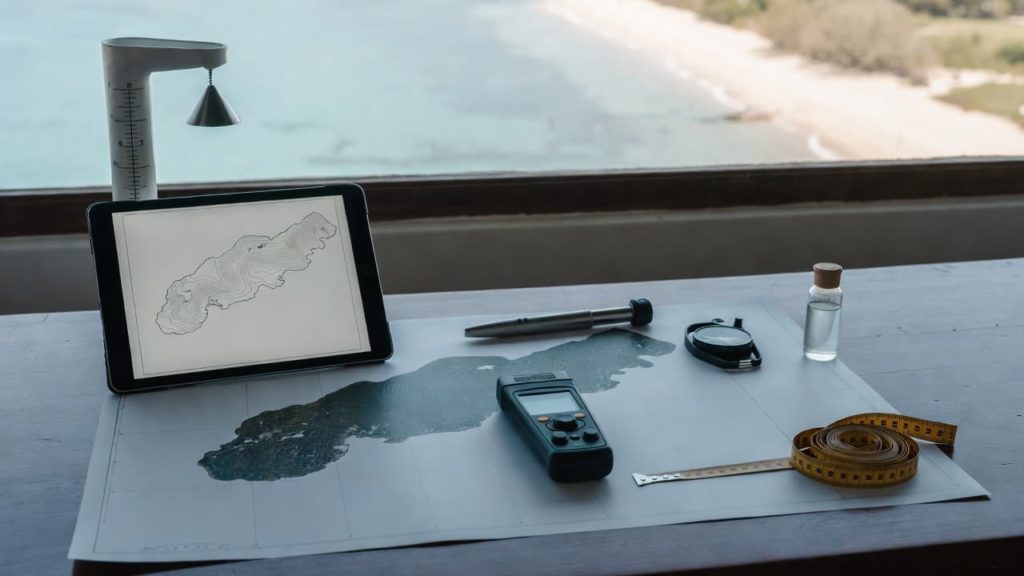
Map your island’s physical limits:
- Size and space: Measure available area for equipment (e.g., tanks, desalination units) and note slopes, beaches, or protected zones.
- Geology screening: Identify rock type (limestone/carbonate for potential freshwater lens; volcanic for lower recharge) and soil porosity and permeability. Consult a hydrogeologist for groundwater feasibility – do not assume viability without testing.
- Proximity: Note distance to mainland or nearby supply hubs and typical sea conditions to assess delivery or pipeline feasibility.
Gather Climate and Rainfall Data
Review multiple years of data for reliability – avoid basing plans on one good year:
- Average annual rainfall and monthly distribution.
- Variability and drought frequency (e.g., consecutive dry months).
- Storm exposure (hurricane season, flood risk affecting storage).
Use multi-year rainfall totals and seasonality to evaluate whether rainwater can reliably cover demand with storage.
Assess Energy Availability and Cost
List your power setup:
- Sources: Grid (rare), diesel generators, solar (daily sunlight hours, panel space).
- Cost: Track your effective energy cost per unit (diesel, grid, or solar + storage). Higher energy costs generally make efficiency and solar integration more attractive.
Energy drives desalination viability – log current rates and future changes.
Inventory Existing Infrastructure
Catalog what you have:
- Water: Current sources, storage tanks (size, type: above-ground or underground), pipes, pumps, filters and UV.
- Power and monitoring: Generators, solar arrays, controls, sensors.
Define Budget and Planning Horizon
Set your timeframe: choose a planning horizon that aligns with long-term costs and expected expansions.
Decision Tree: Choosing Your Primary Water Supply Method
Use this step-by-step tree to match data to options. Plan redundancy: one primary method plus backups and sufficient storage.
- Is rainfall sufficient and consistent across multiple years for your storage strategy?
- Yes → Rainwater harvesting as primary; RO or wells as backup.
- No → Next question.
- Groundwater feasible (freshwater lens via geology screen, low intrusion risk)?
- Yes (hydrogeologist-confirmed) → Wells primary with monitoring; RO backup.
- No → Next question.
- Mainland or nearby island proximity close enough for reliable delivery?
- Yes → Barge or pipeline supplemental; pair with storage.
- No → Next question.
- Demand and energy cost profile?
- Match RO capacity and power system design to your peak demand, storage autonomy target, and energy constraints.
- Final: Implement a hybrid approach: one primary method plus backups and enough storage to maintain continuity during failures.
Checklist: Pre-Implementation Site Assessment
- Record multi-year rainfall totals, seasonality, and drought frequency.
- Screen geology (limestone or volcanic; porosity).
- Calculate peak occupancy and demand (m³/day with buffer).
- Record mainland/supply-hub proximity and typical delivery conditions.
- Map available space for tanks and equipment.
- Log energy sources and effective cost per unit of energy.
- Assess groundwater access (preliminary; flag for hydrogeologist).
- Inventory existing infrastructure (tanks, pumps, power).
- Note environmental sensitivity (reefs, protected areas).
- Set your planning horizon and expected expansion timeline.
- Document storm and drought exposure.
- Research local regulations and permits (consult authorities).
Desalination (Reverse Osmosis): Sizing, Energy, and Reliability
Reverse osmosis, or RO, is the most common technology for private island drinking water, especially where other sources fall short. It reliably converts seawater into freshwater using proven membrane systems, making it a go-to for islands of all sizes.
RO works by forcing seawater through semi-permeable membranes under high pressure. These membranes allow water molecules to pass while blocking salt and impurities, removing the vast majority of dissolved salts and many impurities, depending on system design and operation. With appropriate pretreatment, post-treatment, and verification testing, RO product water can be managed to meet applicable drinking-water standards.
Energy drives the process, and energy use varies by system design, feedwater quality, recovery rate, and whether energy-recovery devices are used. Use vendor data for your specific capacity and site conditions. Since energy often accounts for most operational expenses, your island’s power source – diesel, grid, or solar – directly impacts long-term costs.
Scale RO to your daily demand calculated in Step 1 (m³/day), plus a buffer. Systems range from compact units for private islands to larger setups for resorts or communities.
Use a vendor-sized design package (process flow, power draw, consumables, spares, and maintenance plan) to validate feasibility and lifecycle costs.
Solar RO for Off-Grid Islands
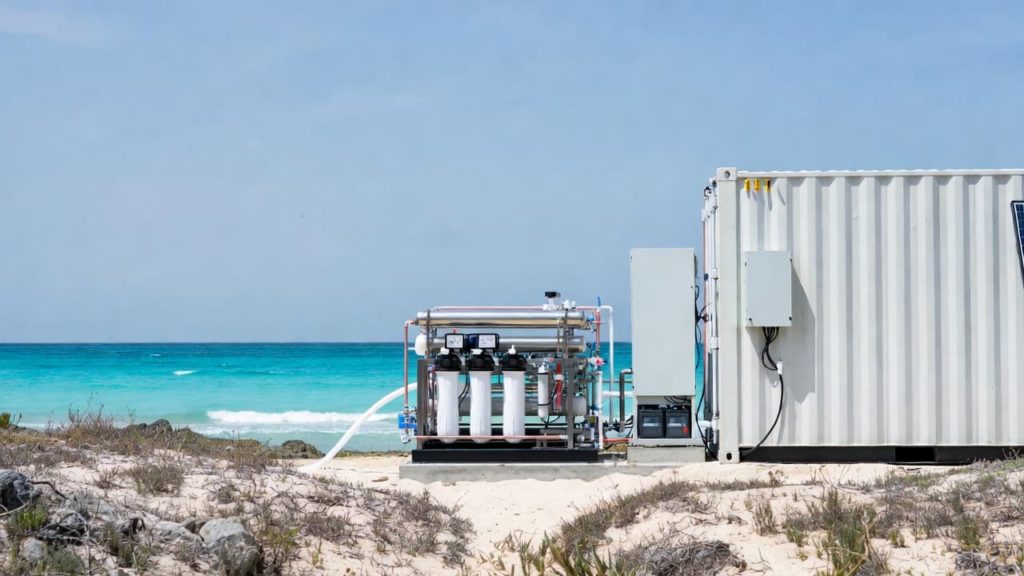
Solar desalination, or solar RO, pairs RO with photovoltaic panels for energy independence. This approach is suitable for remote islands with consistent sunlight, reducing reliance on fuel deliveries and cutting emissions compared to diesel-powered traditional RO.
Space and cost scale with capacity, storage requirements, intake/discharge works, and local installation constraints. Request quotes sized to your demand and include storage, pretreatment, spares, and servicing.
For intake, site your system near the shore with a screened seawater pipe to draw from clean depths, avoiding sand and debris. Discharge involves brine – the concentrated saltwater byproduct – which must be designed for local depth, currents, and sensitive habitats. Diffusers can improve initial dilution, but the final design must match site conditions and permitting requirements to avoid localized salinity impacts.
RO at a Glance
- Best for: Low-rainfall islands, high-demand setups, or reliable primary or backup supply.
- Typical constraints: Needs steady energy, coastal access, and space for equipment and brine handling.
- Energy needs: Site-specific; use vendor data based on feedwater, recovery rate, and energy-recovery equipment.
- Space: Varies by capacity and power/storage design (RO skid/container + pretreatment + storage + power equipment).
- Upfront cost: Varies widely by capacity and site works (intake/discharge, power/storage, installation).
- Operational cost per m³: Site-specific; driven by energy, consumables, maintenance, and downtime risk.
- Key risks: Power loss, membrane wear, pump failure; address with backups and maintenance.
Failure Modes and Mitigations
- Membrane fouling (from debris or silt): Regular monitoring and cleaning prevent buildup.
- Pump wear: Keep spares on hand for quick swaps.
- Power outage: Integrate storage tanks, battery backups, or diesel generators.
- Salt creep (brine leaks): Inspect seals and fittings on a regular schedule to prevent corrosion and leaks.
Expect realities like membrane replacement per manufacturer guidance, routine cleaning, and pump checks – these ensure longevity but demand planning. Full maintenance details follow later.
Checklist: Solar Desalination System Planning
- Confirm peak demand and include a buffer for seasonal highs and leakage.
- Secure sufficient unshaded space for the RO unit, pretreatment, power equipment, and access for service.
- Assess seawater intake site (depth, debris-free).
- Verify solar resource seasonality and design the power system for worst-case periods.
- Plan storage autonomy for multi-day low-production periods.
- Budget using site-specific quotes that include intake/discharge works, storage, pretreatment, installation, and spares.
- Arrange owner and staff training for basic operations.
- Set up remote monitoring for pressure and flow alerts.
Rainwater Harvesting: Catchment, Storage, and Reliability
Rainwater harvesting captures precipitation from roofs and other surfaces for use as a drinking water source, serving as a primary or supplemental option depending on local rainfall patterns. It offers a low-energy, sustainable option where conditions allow, but requires careful sizing and storage to handle dry periods.
This method relies on the island’s catchment area, such as roofs or paved surfaces, to collect water during rain events. First-flush diverters discard initial dirty runoff, while screens block leaves and debris. Use screens and first-flush diversion to remove debris, then a sediment filter (micron-rated) for fine particles; use activated carbon for taste/odor and dissolved organics before storage or at point-of-use, depending on your design. Detailed treatment processes follow later in the chain.
Sizing your rainwater system step-by-step
To determine if rainwater can meet your needs, tie the sizing to your daily demand calculated earlier. Use these steps based on historical rainfall data:
- Obtain multi-year average annual rainfall, including minimum years to account for variability – consult local weather records or satellite data.
- Measure your total catchment area (e.g., all usable roof surfaces).
- Apply the sizing formula: annual yield (m³) = catchment area × rainfall × runoff efficiency. Use a conservative efficiency factor appropriate to your surfaces, first-flush diversion, and overflow losses.
- Convert annual yield to a daily average, then plan storage capacity for dry spells to cover several days of demand.
- Compare to your demand using low-rain years and seasonality. If rainwater cannot reliably cover demand with storage, treat it as supplemental and pair it with a backup source.
For illustration (use local multi-year rainfall data):
If catchment area is 500 m², annual rainfall is 1.5 m, and conservative runoff efficiency is 0.75, then:
Annual yield ≈ 500 × 1.5 × 0.75 = 562.5 m³/year → ~1.54 m³/day average.
Storage must still cover dry spells; size tanks for the longest expected low-rain period, not the average day.
Storage tanks: the key bottleneck
Storage tanks determine reliability, as rainfall is seasonal or erratic. Size storage for your autonomy target (days of demand) based on rainfall seasonality and drought risk. Above-ground tanks suit easy access and lower cost but expose to heat and storms; underground options stay cooler and protected but raise installation complexity – choose based on site soil, space, and hurricane risk.
Checklist: Rainwater Harvesting Setup
- Map and measure collection area (roofs, pavements) for the sizing formula.
- Calculate yield: area × rainfall (multi-year average or minimum) × conservative efficiency factor.
- Select storage tanks sized to your autonomy target (days of demand) based on rainfall seasonality and drought risk.
- Install pretreatment at entry: first-flush diverters and leaf screens; add sediment filtration (micron-rated) before storage and carbon filtration at point-of-use or before distribution, depending on your design.
- Position tanks downhill for gravity feed; secure against storms.
- Monitor indicators like pH, sediment, and contamination visually or with basic kits.
- Integrate backup system (RO or well or delivery) triggered by low levels.
- Test full system flow on a regular schedule.
Groundwater and Springs: Wells, Aquifers, and Intrusion Risk
Some private islands offer access to natural freshwater sources like wells tapping into aquifers or rare springs, but success hinges on specific geology and careful management to avoid saltwater intrusion.
Freshwater lens and the Ghyben-Hertzberg concept
A freshwater lens forms when rainwater infiltrates permeable rock layers, creating a floating layer of lighter freshwater atop denser seawater beneath an island. This occurs mainly on limestone or carbonate islands where precipitation infiltrates the ground, recharging the aquifer through high-porosity, permeable formations.
The Ghyben-Hertzberg concept explains this intuitively: imagine the freshwater lens as a dome-shaped body floating on seawater, much thicker below sea level than above it due to density differences. This mental model shows why viability depends on recharge, permeability, island geometry, and pumping rates; real islands often deviate from the simplified interface due to mixing, tides, and heterogeneous geology.
Not all islands qualify; volcanic or low-permeability geology often lacks these conditions, making wells unfeasible from the start.
Saltwater intrusion: the primary risk
Saltwater intrusion happens when over-pumping a well draws down the freshwater lens, allowing denser seawater to migrate inward and upward, mixing with and salinizing the aquifer. Over time, salt diffuses through the lens, degrading water quality progressively. Recovery can take years, even after pumping stops, as the lens slowly replenishes through natural recharge. This risk underscores why wells demand precise management on private islands.
Monitoring and operational constraints
Viable wells require controlled pumping rates matched to aquifer recharge, ongoing salinity monitoring (electrical conductivity tests), and contingency plans like reduced output or switching to backups if quality declines. Springs, where naturally occurring on an island, may provide steady flow but remain rare and site-specific – always verify flow reliability first.
Drilling demands local permits and regulatory approval; consult authorities early. These sources are not free – they need pumps, pipes, treatment, and expert oversight to mitigate intrusion risks. Consult a hydrogeologist before any drilling to assess feasibility.
Groundwater viability quick screen
Use this list to gauge initial potential before investing in professionals:
- Evidence of a freshwater lens: Check historical well data or geophysical surveys showing low-salinity zones.
- Favorable geology: Prioritize limestone or carbonate islands with high permeability and known recharge from precipitation.
- Recharge potential: Multi-year rainfall patterns and infiltration potential (account for drought risk and runoff).
- Historical intrusion risk: Review past well logs for salinity trends or over-pumping incidents.
- Hydrogeologist assessment: Engage a specialist for borehole logs, pump tests, and modeling – essential before any drilling.
Water Delivery: Barges, Boats, and Backup Planning
Water delivery by barge or boat provides a straightforward supplemental option for private island drinking water, especially when mainland proximity supports reliable logistics. Where feasible, a pipeline from the mainland can serve as an alternative, though it requires suitable geography and permits.
Use it to bridge gaps during on-site system installations, repairs, droughts, or storm disruptions when primary methods like rainwater harvesting or desalination are unavailable. It suits islands close to the mainland or larger hubs, where transport times and weather windows make deliveries reliable – check this in your decision tree under the mainland proximity branch to confirm viability.
Delivered water is often one of the highest-cost options long-term, and pricing varies widely by distance, fuel costs, and supplier capacity. Factor in ongoing logistics expenses and supply chain vulnerabilities. Always plan total ownership costs including these variables, treating delivery as a predictable but premium expense.
Infrastructure demands focus on the receiving end. Install storage tanks sized for several days’ demand plus transfer pumps to move water efficiently from boat or barge to your tanks. Buffer capacity here prevents shortages during delayed deliveries, integrating seamlessly into a hybrid approach with a primary on-site source plus backups.
Avoid relying on it alone, as disruptions amplify water-supply risks – build contingency plans accordingly.
Supply disruption reality check
Delivery faces inherent risks that demand redundancy planning:
- Storms or hurricanes block sea access for days or weeks, halting shipments.
- Remote locations extend lead times, raising fuel and coordination costs.
- Supplier shortages or fuel price spikes on the mainland interrupt flow.
Counter these by securing multiple suppliers, oversizing storage, and prioritizing on-site generation for long-term reliability.
Storage and Redundancy
Storage tanks and redundancy form the backbone of a reliable drinking water supply, bridging gaps between inconsistent production and steady demand while guarding against disruptions.
Why storage tanks are essential
Private islands face variable supply from sources like sporadic rainfall or solar-dependent production, yet demand remains constant for drinking, cooking, and hygiene. Storage tanks create a critical buffer, holding enough freshwater to cover several days of use during dry spells or cloudy weather.
They also protect against outages, such as power failures halting pumps, reverse osmosis downtime for cleaning, or delivery delays from storms. Without adequate storage, even a robust primary system risks shortages, underscoring storage as the key reliability lever across all methods.
Tank considerations: above-ground vs underground
Choose tank type based on site specifics. Above-ground storage tanks offer easier access for maintenance and monitoring, lower installation costs, and scalability by adding modules. However, they require more surface space and may need anchoring against high winds or storm surges.
Underground tanks save space and provide natural insulation against heat, reducing algae growth risks, but involve higher upfront digging costs and harder inspections. For storm-prone areas, prioritize elevated or reinforced designs.
Aim for buffer capacity that provides several days of autonomy, scaled to your peak daily demand and production variability.
Redundancy design: primary plus 2 backups
Never rely on a single method – adopt a hybrid approach with one primary supply plus two backups, integrated via shared storage tanks.
Here are three realistic hybrid configuration templates:
- Rainwater-primary plus RO backup: Fits islands with strong multi-year rainfall and ample roof catchment. RO activates during dry seasons. Storage holds multiple days of demand to span gaps. Main constraint: rainfall variability. Emphasize regular tank level checks and RO pre-filters.
- RO-primary plus well backup: Suited to islands with viable groundwater but intrusion risks. RO handles base load; well supplements or covers RO maintenance. Storage buffers multiple days of demand. Main constraint: well monitoring for salinity. Focus on regular well tests and RO membrane spares.
- Solar RO-primary plus barge or storage backup: Ideal for sunny, remote sites with high energy costs. Solar RO runs daily; barge refills during prolonged clouds. Extra storage tanks act as second backup. Main constraint: barge scheduling. Prioritize battery backups and regular intake inspections.
Each template relies on adequate storage as the common thread, with cross-connections that allow manual or automated switching during failures.
Water Treatment and Safety
Health & compliance note: Do not rely on visual clarity or taste. Use certified laboratory testing and follow local drinking-water regulations. Treatment needs differ by source (rainwater, well water, RO product water, delivered water) and by local risks.
Water treatment ensures your drinking water supply meets basic usability standards by removing sediments, organics, and pathogens while balancing taste and minerals. Use a multi-barrier treatment approach tailored to your source, validated by certified lab testing and local drinking-water requirements.
The Standard Treatment Workflow
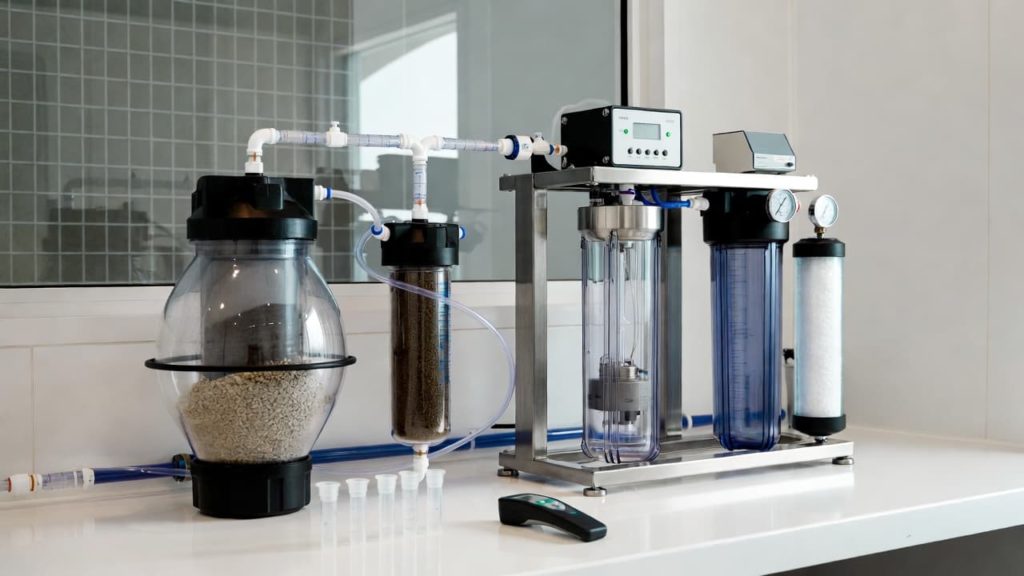
Follow this sequence for most sources: sediment filtration, then carbon filtration, followed by UV purification and/or reverse osmosis (RO) depending on needs, with optional remineralization at the end. Each step builds on the last to protect equipment and improve quality.
- Sediment filtration: Traps dirt, sand, and particles to protect downstream filters from clogging and extend system life.
- Carbon filtration: Removes organics, chlorine tastes, and odors for better palatability and to guard against chemical buildup.
- UV purification: Uses ultraviolet light to inactivate microbes like bacteria without chemicals, effective for biologically vulnerable sources.
- RO (if needed for salts or heavy contaminants): Forces water through a membrane to remove dissolved salts and impurities, essential for seawater-derived or brackish supplies.
- Remineralization (optional final step): Adds trace minerals like calcium and magnesium to improve taste and stability after demineralizing processes like RO.
Source-Specific Treatment Notes
Adapt the workflow based on your primary source for optimal results.
- Rainwater: Start with first-flush diverters and screens to divert initial dirty runoff, then apply full filtration before storage to handle bird droppings or dust.
- Wells: Monitor for salinity changes from potential saltwater intrusion; use pre-sediment filtration and test regularly, adding RO if salts appear.
- RO product water: RO output is low in minerals, so consider remineralization for taste; manage brine discharge separately as part of system design.
- Delivered water: Verify supplier quality on arrival, focus on storage hygiene with sediment and carbon filters, and add UV or testing for last-mile protection.
Water Quality Testing and Treatment Flowchart
Test your water regularly using a qualified lab, focusing on these key indicators: salinity, bacteria, iron, hardness, pH, and sediment or contamination. Use results to adjust treatment – here’s a simple decision guide.
- Test sample from source or storage.
- High salinity? Add or prioritize RO in workflow.
- Bacteria detected? Insert or confirm UV purification step.
- High iron or sediment? Lead with sediment filtration and retest.
- Hardness or pH off-balance? Include carbon filtration and consider remineralization.
- Contamination or organics? Full chain: sediment → carbon → UV or RO.
- Retest post-treatment and monitor regularly; adjust based on trends.
This testing-to-treatment loop reduces recurring quality issues over time.
Maintenance, Monitoring, and Long-Term Reliability
Keeping a private island drinking water supply running reliably over the system’s lifetime requires consistent maintenance, proactive monitoring, and planning for inevitable failures. While some vendors suggest effortless operation, real-world reliability hinges on energy stability, trained staff, and redundancy – power outages alone can cause downtime without proper buffers.
Common failure modes and mitigations
Every water system faces wear from the island environment. Membrane fouling builds up minerals and organics on reverse osmosis membranes, reducing output over time. Salt creep occurs when seawater vapors corrode electrical components in humid conditions. Pump wear from constant operation leads to leaks or total failure. These issues can cause days of downtime if unaddressed, amplifying water-supply risks during peak demand or storms.
Mitigate with routine inspections to spot early wear, scheduled cleaning to restore efficiency, a spare parts inventory for quick swaps, staff training for basic troubleshooting, and remote monitoring systems that send alerts for anomalies like pressure drops.
Typical maintenance schedule
Follow this as baseline guidance, but always adhere to your manufacturer or service provider schedules, which vary by system size and conditions.
- Routine checks: inspect intake, pumps, filters, storage levels, and alarms on a regular schedule.
- Membrane/RO servicing: follow vendor instructions for cleaning and performance verification.
- Water quality testing: use a lab/testing plan appropriate to your source and local regulations.
Common Mistakes and Pitfalls checklist
Avoid these frequent errors that lead to costly disruptions in drinking water supply.
- Undersizing storage tanks: Fails during dry spells or breakdowns; consequence: emergency deliveries at premium rates.
- Ignoring saltwater intrusion risk: Overpumping wells contaminates aquifers for years; consequence: full system redesign.
- Choosing reverse osmosis without energy cost analysis: High energy costs erode savings; consequence: operational expenses exceed expectations.
- Poor brine discharge planning: Concentrated discharge harms marine life, triggers fines; consequence: shutdown and redesign.
- Inadequate maintenance training: Staff miss fouling early; consequence: weeks of downtime and repairs.
- No redundancy: Single-method reliance collapses in storms; consequence: water scarcity for occupants.
Sustainability and Environmental Impact
A reliable drinking water supply must balance energy efficiency, emissions reduction, and minimal marine disruption while ensuring long-term viability amid climate shifts. This section outlines key tradeoffs and strategies to minimize environmental footprint without sacrificing dependability.
Energy sources and emissions
Water production systems rely heavily on energy, often accounting for a significant portion of an island’s power needs. Diesel generators offer quick setup but increase fossil fuel reliance and greenhouse gas emissions, raising the carbon footprint over time. Grid connections, where available, provide stability but may still depend on non-renewable sources, limiting energy independence. Solar integration stands out for sustainability, reducing emissions by replacing diesel with renewable power and fostering self-sufficiency for systems like desalination.
For off-grid islands, pairing water production with solar reduces long-term emissions and ties into lower operational ranges when energy costs are high.
Brine discharge considerations
Reverse osmosis produces brine as concentrated seawater waste, which requires careful handling to avoid harming marine ecosystems. Impacts depend on discharge methods and site sensitivity, such as proximity to coral reefs or marine life habitats. Diffusers can improve initial dilution, but outcomes depend on depth, currents, seabed conditions, and discharge siting near sensitive habitats. Always assess environmental sensitivity during site planning and consult local authorities for intake and discharge permits to ensure compliance.
Climate resilience and future-proofing
Private islands face escalating risks from climate change, including more intense hurricanes, storm surges, prolonged droughts, and sea-level rise, all of which threaten water infrastructure. Proactive design builds resilience: plan for changing rainfall patterns by oversizing storage, and address sea-level rise through elevated infrastructure.
Climate Resilience Planning
Match these common risks with targeted mitigations to protect your water supply:
- Storm surge: Use elevated intake piping to prevent seawater backflow into systems.
- Saltwater flooding: Install battery backups for pumps and controls to maintain operation during power outages.
- Drought: Incorporate redundant storage across multiple tanks for extended dry periods.
- Sea-level rise: Reconfigure discharge points and elevate key components like intakes and tanks.
Solar desalination enhances this framework by cutting diesel dependence, supporting reliability in variable conditions while aligning with sustainability goals.
Cost Comparison and ROI
Evaluating the financial side of a drinking water supply requires comparing initial investment against ongoing operational costs, expressed as cost per cubic meter of water produced or delivered. This section breaks down cost components for key methods to guide realistic budgeting.
ROI Calculation Structure (use your own quotes)
- Define planning horizon (e.g., 5-15 years) and peak-demand design target (m³/day).
- CapEx: equipment + intake/discharge or drilling + tanks + installation + permitting + commissioning.
- OpEx: energy + consumables (filters/membranes/chemicals) + lab testing + labor/service contracts + spares + logistics.
- Reliability cost: expected downtime days/year × cost of emergency water delivery (or lost occupancy).
- Compare scenarios on cost per m³ delivered to the tap and total cost over the horizon.
Cost Components by Method
- RO or desalination: CapEx covers equipment, installation, intake/discharge systems, and civil works. OpEx driven by energy, membrane replacement, pump maintenance, and monitoring.
- Solar RO: CapEx covers RO equipment, solar panels, batteries, storage, and installation. OpEx driven by consumables, membrane servicing, spares, and monitoring; operating energy costs depend on system design, storage, and performance in low-sun periods.
- Imports or delivery: Minimal CapEx beyond storage and transfer infrastructure. OpEx highly variable and often high long-term, driven by transport, fuel, supplier logistics, and weather disruptions.
- Rainwater harvesting: Low CapEx for catchment surfaces, gutters, tanks, and filtration. OpEx near zero beyond routine maintenance. Weather dependency may require backup systems, adding indirect cost.
- Wells: CapEx for drilling, pump setup, and monitoring infrastructure. OpEx for pumping energy, monitoring, and maintenance. Geology risks like saltwater intrusion can lead to high remediation costs.
Costs vary widely by region, geography, system scale, and local energy prices – always obtain quotes from multiple suppliers for your island’s specifics.
Frequently Asked Questions
No single method is universally reliable, as effectiveness depends on rainfall patterns, groundwater feasibility, energy availability, and daily demand. The strongest approach uses a hybrid system with one primary source plus at least two backups, such as rainwater harvesting as primary with reverse osmosis and barge delivery as redundancies. This spreads risk across water-supply risks like drought or equipment failure.
Costs vary widely by capacity, intake/discharge works, storage autonomy requirements, power system design, installation logistics, and permitting. Use site-specific vendor quotes and include consumables, spares, servicing, and monitoring in lifecycle costs.
Rainwater-only systems can work where multi-year rainfall is sufficient and storage can bridge dry periods. In many locations, rainwater is best treated as supplemental and paired with a backup source and adequate storage to cover droughts and maintenance downtime.
Saltwater intrusion occurs when over-pumping draws seawater into a freshwater aquifer, contaminating the supply. It is a major issue for island wells because recovery can take years even after reduced pumping, often requiring abandonment or advanced monitoring to prevent.
Space needs depend on capacity and design. Account for the RO unit, pretreatment, storage tanks, power equipment (diesel/solar/batteries), and safe access for service, plus intake and discharge infrastructure.
Reliability depends on power storage, water storage autonomy, and backup sources. Design for low-production periods and storm disruptions using adequate storage, backup power, and a secondary water source.
Maintenance typically includes intake and pretreatment checks, filter changes, membrane cleaning and performance verification per vendor guidance, pump and seal inspections, spare parts management, and regular water quality testing. Remote monitoring and trained operators reduce downtime.
Estimate peak occupancy and typical per-person use, then add all non-potable loads (laundry, kitchens, pools/spas, landscaping, staff operations) and include a peak-demand buffer. Convert the result to a daily volume target and size storage and production for worst-case periods.
Brine from desalination is typically discharged offshore; diffusers can improve initial dilution, but the final design depends on depth, currents, seabed conditions, sensitive habitats, and permitting requirements. Some setups explore alternative uses like salt production or aquaculture feeds, though this requires site-specific feasibility.
Installation time depends on permitting, site preparation, intake and discharge works, delivery logistics, and integration with power and storage. Use vendor timelines tied to a defined scope and permitting path.
Approvals vary by location but typically include permits for intake and discharge (especially brine), water quality compliance, drilling (if pursuing wells), and building codes for storage tanks. Environmental review may apply near sensitive areas like reefs. Always consult local authorities early in planning to avoid delays and ensure compliance.
Sources
- https://www.who.int/publications/i/item/9789240045064
- https://www.who.int/publications/i/item/WHO-HSE-WSH-11.03
- https://www.epa.gov/privatewells/protect-your-homes-water
- https://www.cdc.gov/drinking-water/safety/guidelines-for-testing-well-water.html
- https://www.cdc.gov/drinking-water/prevention/water-treatment-hiking-camping-traveling.html
- https://iris.who.int/server/api/core/bitstreams/5166139c-8145-451f-b429-094a63f65bce/content
- https://www.twdb.texas.gov/publications/reports/numbered_reports/doc/r363/c8.pdf
- https://www.energy.gov/documents/73355-7pdf
- https://www.waterboards.ca.gov/water_issues/programs/ocean/desalination/docs/dpr051812.pdf
- https://documents1.worldbank.org/curated/en/476041552622967264/pdf/135312-WP-PUBLIC-14-3-2019-12-3-35-W.pdf
- https://faolex.fao.org/docs/pdf/mdv189834.pdf
- https://www.mdpi.com/2073-4441/16/10/1402
- https://pubs.usgs.gov/circ/2003/circ1262/