Private Islands for Sale in the Philippines
Table of contents
- Short answer
- Islands for sale in the Philippines right now
- How much does a private island cost in the Philippines?
- Can foreigners buy an island in the Philippines?
- Land titles, forest land and the shore
- Where are the private islands in the Philippines?
- Getting there, seasons and natural risks
- Costs of buying and owning an island in the Philippines
- How to buy or lease an island in the Philippines: step by step
- Risks and what to check
- Frequently Asked Questions
- Sources
Short answer
You can buy a private island in the Philippines only if you are a Filipino citizen or a company that is at least 60% Filipino-owned. Foreigners cannot own land, including islands. They can lease an island, hold up to 40% of a Philippine company that owns it, or own the buildings on it.
As of November 2026, whole islands are listed from about ₱25 million (US$391,000). Most cost ₱75–400 million (US$1.2–6.3 million), and the largest reach ₱2 billion (US$31 million).
Before you pay, check two things: whether the island has a real land title, and whether it is classed as forest land or a protected area. Many islands for sale have neither a title nor a clear right to build.
Islands for sale in the Philippines right now
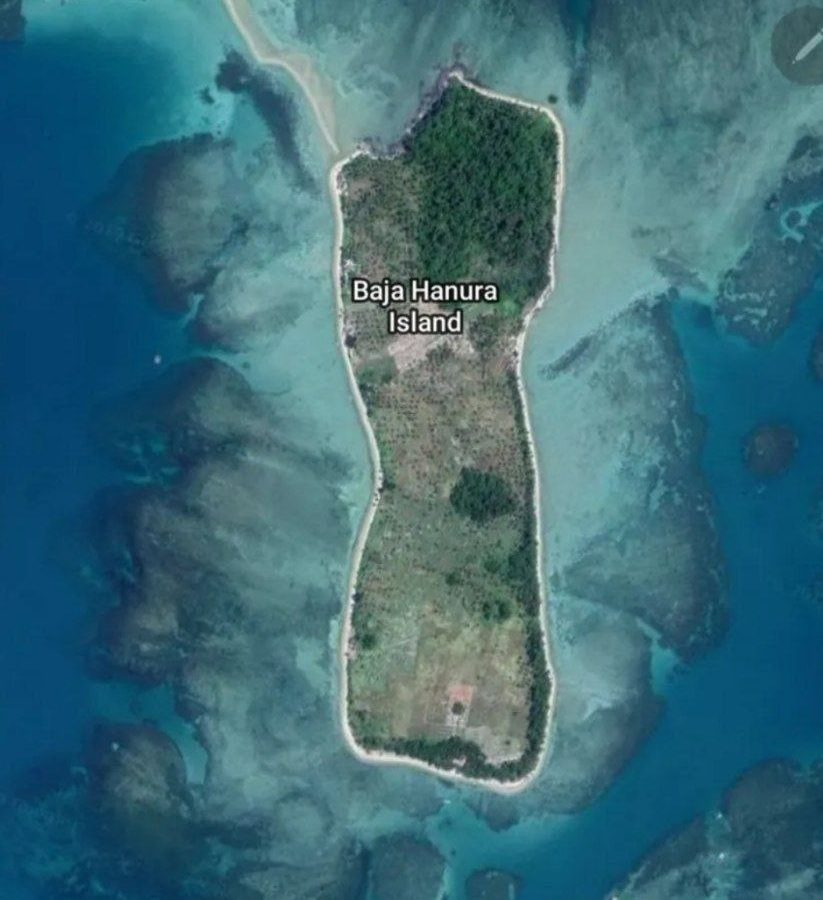
These are the Philippine islands listed on FindIslands. You can also see all islands tagged Philippines or browse all islands for sale.

Selling an island in the Philippines? List it on FindIslands →
How much does a private island cost in the Philippines?
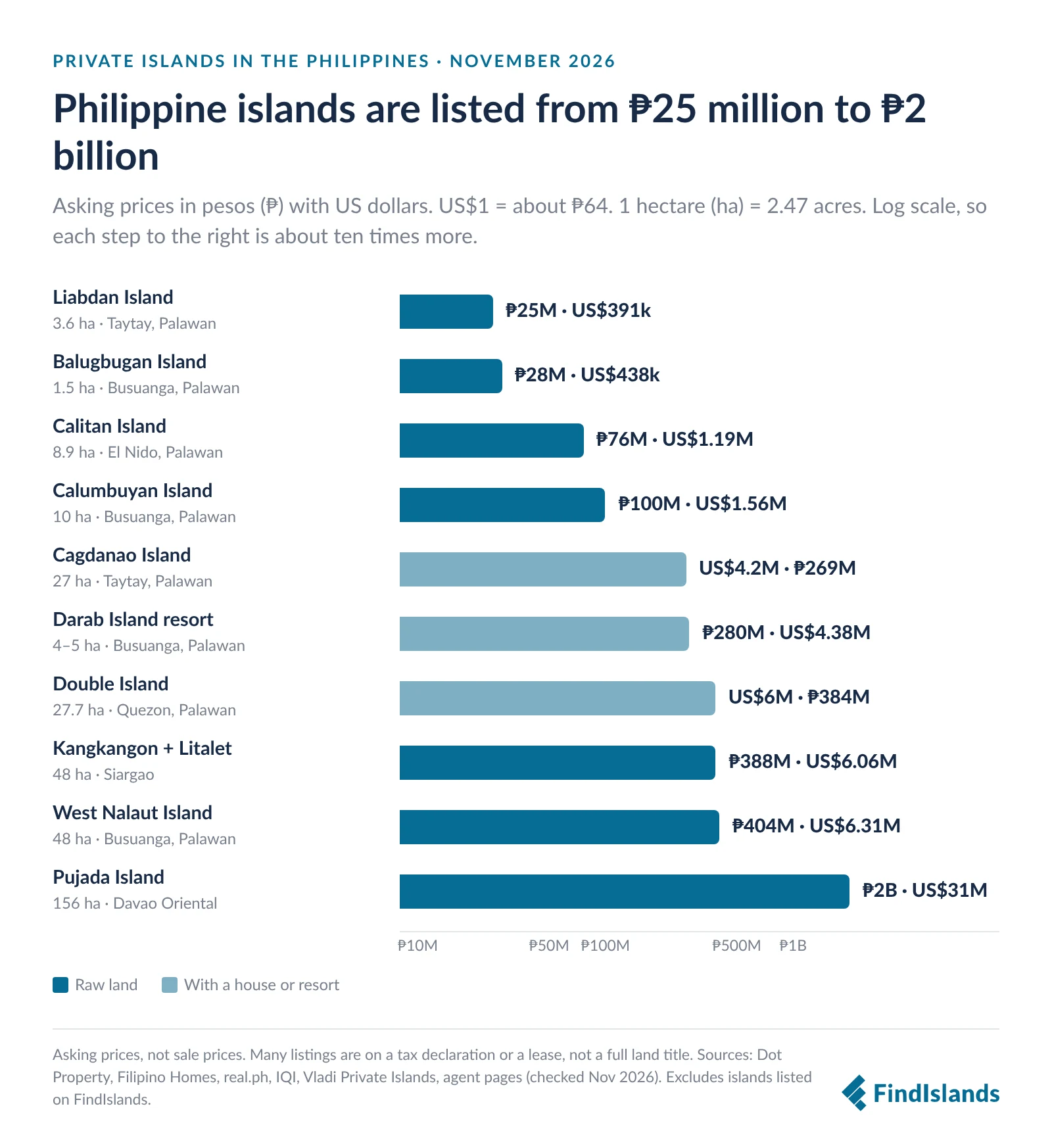
Prices are listed in pesos (₱) or US dollars. US$1 is about ₱64. Land is measured in hectares (ha): 1 hectare is 2.47 acres. These are other listings on the market that we checked, as of November 2026.
| Island | Area | Size | Asking price | What you get |
|---|---|---|---|---|
| Liabdan Island | Taytay, Palawan | 3.6 ha | ₱25 million (US$391,000) | Raw land, tax declaration only |
| Balugbugan Island | Busuanga, Palawan | 1.5 ha | ₱28 million (US$438,000) | Raw land |
| Calitan Island | El Nido, Palawan | 8.9 ha | ₱76 million (US$1.19 million) | Raw land, tax declaration |
| Calumbuyan Island | Busuanga, Palawan | 10 ha | ₱100 million (US$1.56 million) | Raw land |
| Cagdanao Island | Taytay, Palawan | 27 ha | US$4.2 million (₱269 million) | Villas and cabanas on a forest-land lease |
| Darab Island resort | Busuanga, Palawan | 4–5 ha | ₱280 million (US$4.38 million) | Small resort on a forest-land lease |
| Double Island | Quezon, Palawan | 27.7 ha | US$6 million (₱384 million) | Owner’s house, titled |
| Kangkangon and Litalet | Siargao | 48 ha | ₱388 million (US$6.06 million) | Two raw islands, tax declarations |
| West Nalaut Island | Busuanga, Palawan | 48 ha | ₱404 million (US$6.31 million) | Raw, partly titled, approvals for villas |
| Pujada Island | Davao Oriental | 156 ha | ₱2 billion (US$31 million) | Raw land, titled |
Sources: Dot Property, Filipino Homes, real.ph, IQI and Vladi Private Islands (pages checked November 2026). Prices are asking prices and change often.
What this means for a buyer:
- The title matters more than the price. A titled island costs much more than one sold on a tax declaration or a lease.
- Palawan has the most islands for sale. Most listings are around Coron, Busuanga, El Nido and Taytay.
- Resort islands are often on leased forest land. You buy the business and the lease, not the land.
What is the cheapest private island in the Philippines?
The cheapest whole island we found in November 2026 was Liabdan Island in Taytay, Palawan: 3.6 hectares for ₱25 million (US$391,000). It is sold on a tax declaration, not a land title.
We found no whole island with a land title for under US$50,000. Very cheap “islands” online are usually a small part of an island, a tiny rock, or “rights” to land without a title. Treat them with care.
Can foreigners buy an island in the Philippines?
No, not in their own name. The Philippine Constitution allows only Filipino citizens and companies at least 60% Filipino-owned to own land. This applies to islands too. A foreigner can still own the buildings on an island.
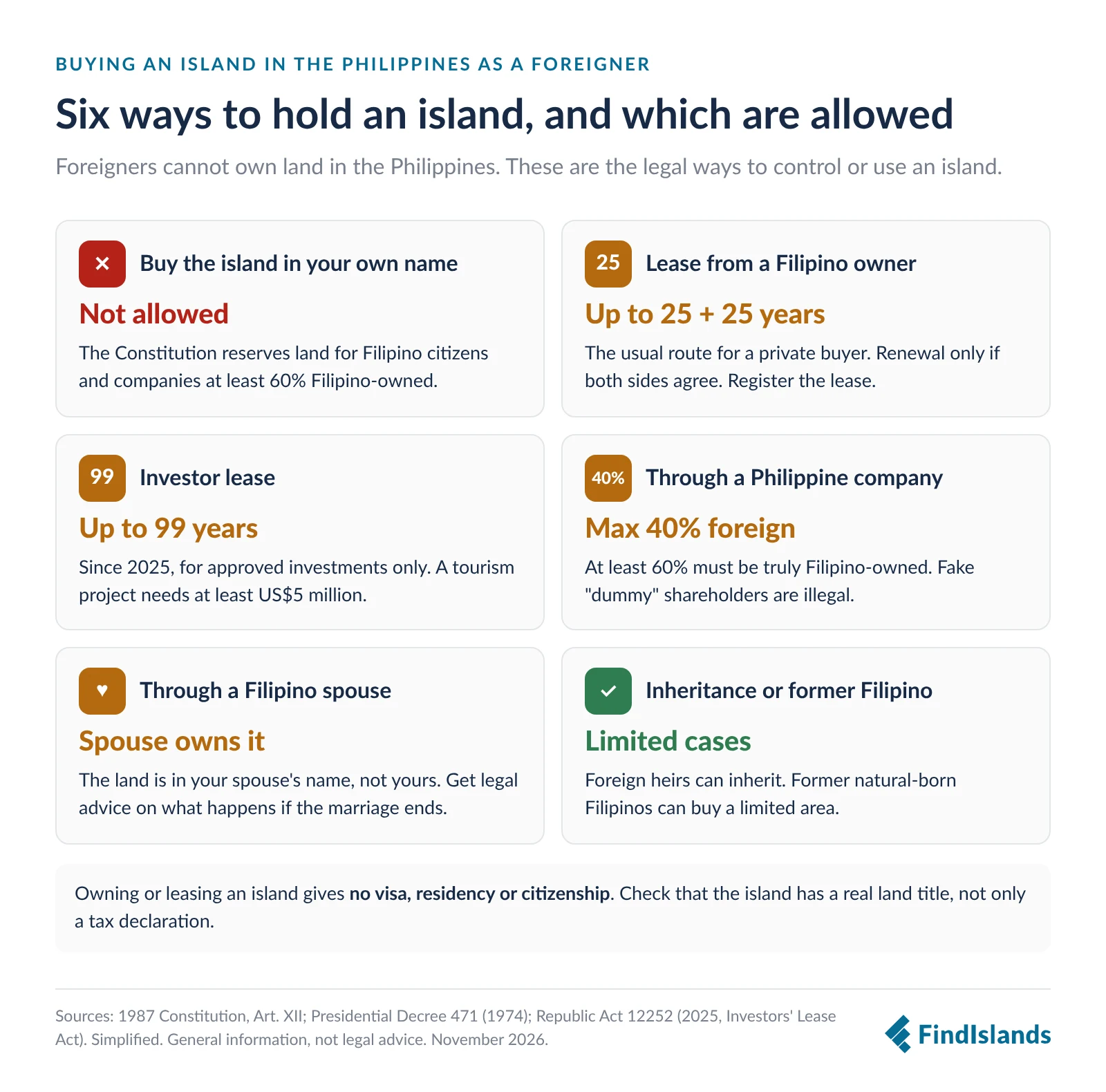
The legal routes:
- A lease from a Filipino owner: up to 25 years, renewable for another 25 if both sides agree. This is the usual route for a private buyer.
- An investor lease: since 2025, approved foreign investments can lease land for up to 99 years in total. A tourism project needs at least US$5 million of investment. It is not a route for a holiday home.
- A Philippine company: foreigners can own up to 40%. The Filipino owners must be real. Using Filipino “dummies” to hide foreign control is illegal, and the land can be lost.
- A Filipino spouse: the land is in your spouse’s name, not yours.
- Inheritance and former Filipinos: foreign heirs can inherit land. Former natural-born Filipinos can buy a limited area.
Owning or leasing an island does not give you residency, a visa or citizenship in the Philippines. Retirees can apply for the Special Resident Retiree’s Visa (SRRV), which has its own rules.
Land titles, forest land and the shore
Many islands look private but are not fully private land. Check three things.
- A land title or only a tax declaration. A land title (often called a TCT or OCT) proves ownership. A tax declaration only shows who pays the land tax. It does not prove you own the land.
- Forest land and protected areas. Many islands are classed as forest land, which belongs to the state. You cannot buy it, only lease it for tourism under a government agreement. Islands inside protected areas have strict limits on building.
- The shore. The beach below the high-tide line belongs to the state. The law also keeps a strip along the shore free of buildings: 20 metres on farm land and 40 metres on forest land. The government has ordered resorts in El Nido and Coron to take down buildings inside this strip.
Some islands are also inside the ancestral land of indigenous peoples. Any use there needs their formal consent.
Where are the private islands in the Philippines?
- Palawan: the biggest market, around Coron, Busuanga, El Nido, Taytay and Quezon. The whole province has extra environmental rules.
- Visayas: islands off Cebu, Bohol and Negros. Close to airports, but fewer listings.
- Siargao and Mindanao: surf islands around Siargao and large raw islands in the south.
- Luzon: Caramoan, Calaguas and Catanduanes in the east, and islands off Batangas south of Manila.
See more islands across the region in Asia, or compare with our guide to private islands for sale in India.
Getting there, seasons and natural risks
- Getting there: fly to Manila or Cebu, then on to a regional airport such as Busuanga (Coron), El Nido, Puerto Princesa or Siargao. From there you go by boat. Traditional outrigger boats (bancas) are common.
- Dry season: about December to May. This is the best time to visit and to build.
- Typhoons: about 20 storms a year enter Philippine waters, mostly from June to November. Typhoon Haiyan (2013) and Typhoon Rai, known locally as Odette (2021), hit island areas hard.
- Earthquakes: the country is on an active fault zone. Build to a good standard.
Most islands have no grid power or town water. Our guides to island energy supply and drinking water on a private island explain the options.
Costs of buying and owning an island in the Philippines
| Cost | Typical rate | Who usually pays |
|---|---|---|
| Capital gains tax | 6% of the price or official value, whichever is higher | Seller |
| Documentary stamp tax | 1.5% | Buyer |
| Local transfer tax | 0.5% in the provinces | Buyer |
| Registration and notary fees | About 1–2% in total | Buyer |
| Lawyer | Agreed with the lawyer | Buyer |
On a lease, different taxes apply. Ask your lawyer.
Every year you pay real property tax to the province, usually up to 1% of the assessed value. Add the costs of a boat, staff, fuel, power, water and typhoon repairs.
How to buy or lease an island in the Philippines: step by step
- Hire a Philippine lawyer before you sign anything or pay a deposit.
- Choose the route: a lease, a company, or a Filipino spouse or partner as the owner.
- Check the title at the Registry of Deeds. A tax declaration alone is not enough.
- Check the land class with the environment department: private land, forest land or a protected area.
- Check the shore strip, building rules and any indigenous land claims.
- Sign and register the deed of sale or the lease, and pay the taxes.
- Get the permits before you build, including the environmental certificate.
If you are offered a lease, read our guide to freehold vs leasehold islands.
Risks and what to check
- No real title: many islands are sold on a tax declaration or “rights” only.
- Forest or protected land: you may not be able to buy or build at all.
- Dummy arrangements: hiding foreign ownership behind Filipino names is illegal.
- Overlapping claims: families, neighbours or indigenous communities may claim the same land.
- Typhoons: plan buildings, insurance and evacuation for storms.
A Philippine property lawyer should check the title, the land class and the lease or company documents before you sign anything.
Frequently Asked Questions
Only Filipino citizens and companies at least 60% Filipino-owned can buy land, including islands. Foreigners can lease an island, hold up to 40% of a company that owns it, or own the buildings on it.
No. The Constitution does not allow foreigners to own land. A long lease or a minority share in a Philippine company are the legal options.
As of November 2026, whole islands were listed from about ₱25 million (US$391,000) to ₱2 billion (US$31 million). Most cost ₱75–400 million (US$1.2–6.3 million).
We found no whole island with a land title at that price. Very cheap offers are usually a part of an island, a tiny islet, or land without a title.
Up to 25 years, renewable for 25 more by agreement. Approved foreign investments can lease land for up to 99 years.
A record that shows who pays the land tax. It is not proof of ownership. A land title from the Registry of Deeds is.
No. Owning or leasing property gives no visa or residency. Retirees can apply for the SRRV retirement visa.
Mostly from June to November. The dry season, from about December to May, is the best time to visit.
Prices are asking prices unless marked sold, not valuations. This guide is general information, not legal or tax advice.
Sources
- https://ndvlaw.com/can-foreigners-legally-own-land-in-the-philippines/
- https://ndvlaw.com/the-philippines-liberalizes-the-lease-of-private-lands-by-foreign-investors-through-republic-act-no-12252/
- https://www.philstar.com/business/2025/09/05/2470698/foreigners-can-now-lease-land-philippines-99-years
- https://jur.ph/law/summary/fixing-a-maximum-period-for-the-duration-of-leases-of-private-lands-to-aliens
- https://www.lawyer-philippines.com/articles/structuring-foreign-ownership-of-a-private-island-in-the-philippines
- https://palawandailynews.com/provincial-news/denr-to-demolish-violators-of-coastal-easement-in-el-nido-and-coron
- https://www.pagasa.dost.gov.ph/climate/tropical-cyclone-information
- https://listd.ph/blog/property-taxes-fees-buying-guide