Islands for Sale in Scotland
Table of contents
- Short answer
- Islands for sale in Scotland right now
- How much does an island cost in Scotland?
- Can foreigners buy an island in Scotland?
- What you own: the beach, the seabed and public access
- Community right to buy
- Crofts on islands
- Building on a Scottish island
- What it is like to own an island in Scotland
- Where to buy
- How to buy an island in Scotland
- Costs of buying and owning
- Risks and what to check
- Frequently Asked Questions
- Related guides
- Sources
Short answer
Yes. Scotland is one of the few places in Europe where you can own a whole island outright. Anyone can buy, including foreigners.
Islands that came to market in 2023–2026 asked from £50,000 (US$67,000) for a small tidal islet to £6.5 million (US$8.7 million) for an estate island with two houses. Most uninhabited islands asked £120,000–£500,000 (US$160,000–670,000).
Three things make Scotland different from buying a house:
- the beach below the high-water mark often belongs to the Crown, not to you;
- the public has a right to walk on most land, islands included;
- many islands are nature sites, where building needs extra approval.
Islands for sale in Scotland right now
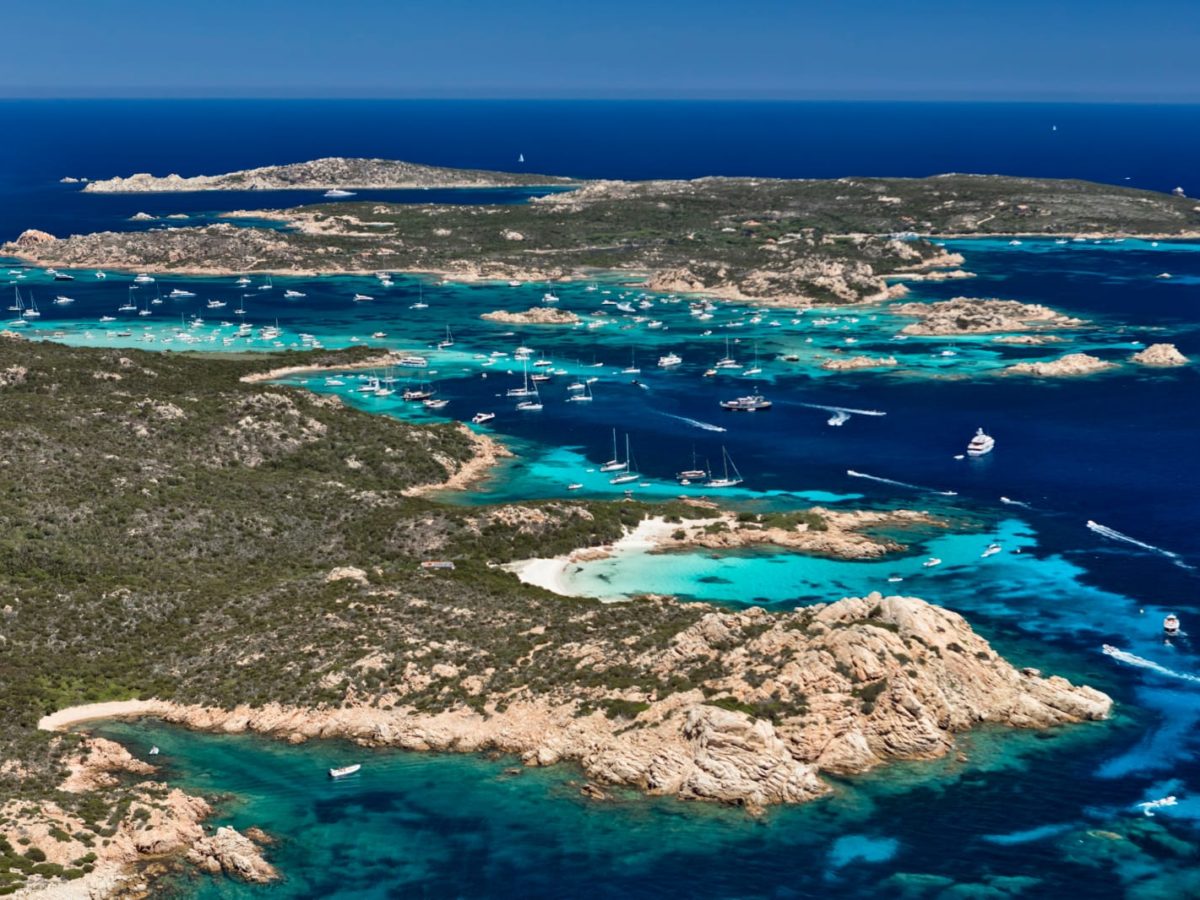
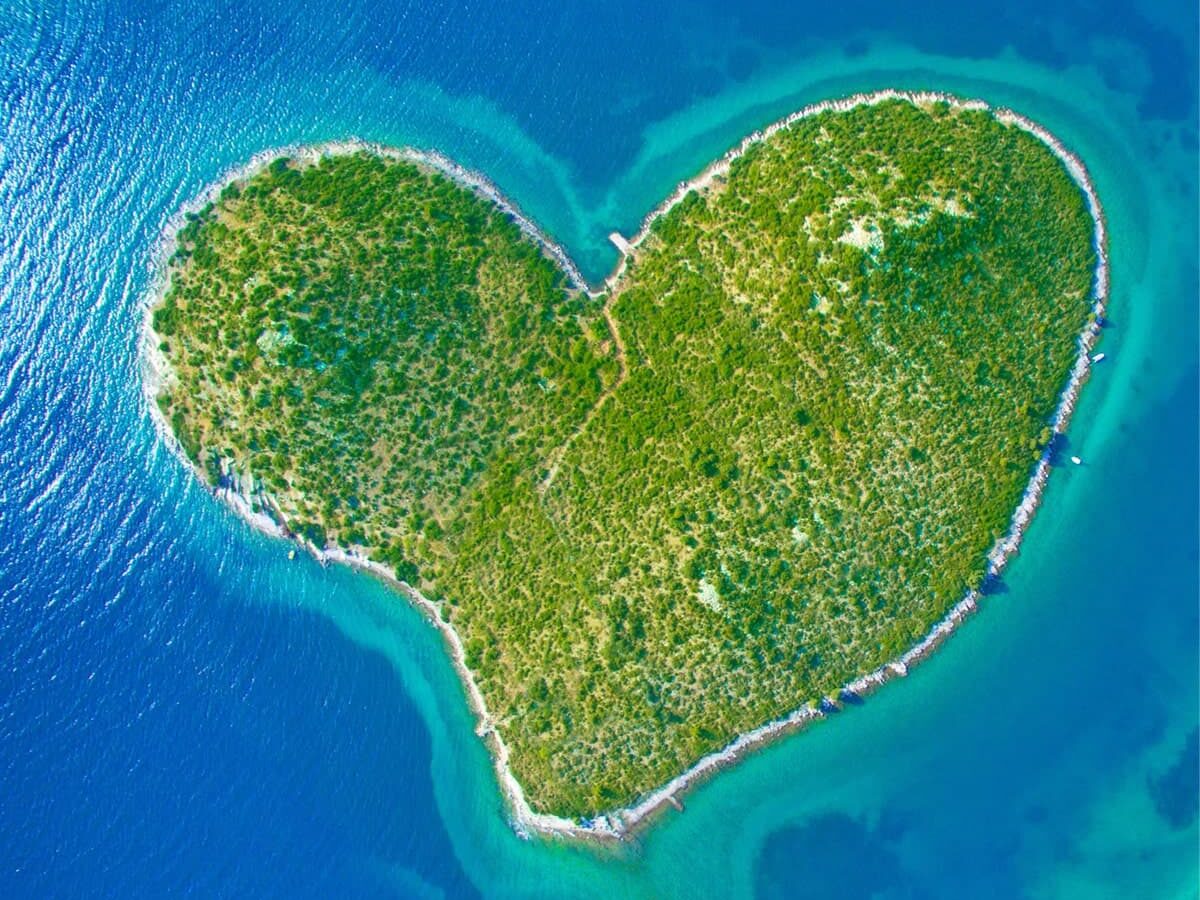
FindIslands does not list an island in Scotland yet. Below are other islands in Europe from our catalogue. You can also browse all islands for sale.
Islands for sale elsewhere in Europe

Selling a Scottish island? List it on FindIslands →
How much does an island cost in Scotland?
There is no public record of island sales, and many deals are private. The best guide is what agents have asked. These are the whole islands we could check that were listed or auctioned between 2023 and October 2026. Dollar figures use £1 = US$1.34.
| Island | Where | Size | What’s on it | Asking price | Status |
|---|---|---|---|---|---|
| Eilean a’ Chapuill | Knapdale, Argyll (tidal) | 5 acres | Boathouse only | Offers over £50,000 ($67k) | Under offer, 2026 |
| Gasker | West of Harris | 71 acres | No buildings, seal colony | Offers over £120,000 ($161k) | Sold, price not disclosed, 2025 |
| Barlocco | Fleet Bay, Dumfries & Galloway (tidal) | 25 acres | No buildings, nature site | Offers over £150,000 ($201k) | Listed 2023 |
| Eilean Mòr | Loch Sunart, Highland | 30 acres | Uninhabited, nature site, no consent to build | Offers over £325,000 ($436k) | Listed Aug 2025 |
| Hildasay | Shetland | 272 acres | Stone bothy, small pier | Offers over £350,000 ($469k) | For sale, Oct 2026 |
| Mullagrach | Summer Isles, Wester Ross | 89 acres | Off-grid cabin | £500,000 ($670k) in 2024; auction guide £350,000 ($469k) in 2026 | Auctioned Jun 2026, result not published |
| Inchmoan | Loch Lomond | 113 acres | Ruined lodge, beaches | Offers over £895,000 ($1.2m) | Under offer, 2025 |
| Isle of Wiay | Off Benbecula, Outer Hebrides | 970 acres | Old stone cottage, lochs | Offers over £995,000 ($1.33m) | For sale, Sep 2026 |
| Harbour Island | Loch Crinan, Argyll | 10 acres | Four-bed house, pontoons, mains power | Offers over £1.25m ($1.68m) | Under offer, Aug 2026 |
| Inchmarnock | Firth of Clyde, off Bute | 662 acres | House, working farm | Offers over £2m ($2.68m) | Listed Jun 2025 |
| Inchconnachan | Loch Lomond | 100+ acres | Planning consent for a holiday lodge | £2.5m ($3.35m), cut from £3m | For sale, Oct 2026 |
| Shuna | Firth of Lorn, Argyll | 1,110 acres | Eight houses, ruined castle, farm | £5.5m ($7.37m) | Listed Jun 2025 |
| Eilean Rìgh | Loch Craignish, Argyll | 261 acres | Two houses, helicopter hangar | Offers over £6.5m ($8.71m) | For sale, Jul 2026 |
What this means for a buyer:
- Size hardly decides the price. Asking prices run from about £1,000 ($1,340) per acre on Wiay to over £100,000 ($134,000) per acre on Harbour Island. You pay for a house, planning consent, mains services and easy access.
- Under £200,000 ($268,000) buys an empty island. Expect no house and no consent to build one. Some are protected nature sites.
- A proper house with mains services starts at about £1 million ($1.34 million). Below that you get a bothy or an off-grid cabin at best.
- Prices can fall as well as rise. Inchmarnock went from £1.4 million ($1.9 million) in 2019 to £2 million ($2.7 million) in 2025. Mullagrach went the other way, from £500,000 to an auction guide of £350,000.
- Very few come up. In late October 2026, the main UK land portal listed just three whole islands for sale, only one of them in Scotland.
Can foreigners buy an island in Scotland?
Yes. Scotland has no restrictions on who can own land and no approval process for foreign buyers.
You can buy in your own name, jointly, or through a company or trust. Two extra rules apply if you do not buy in your own name:
- A non-UK company must first be on the UK Register of Overseas Entities.
- A trust, partnership or nominee must name the people who really control the land on Scotland’s register of controlling interests. Not doing so is an offence.
Listings in England say “freehold”. In Scotland you simply get ownership of the land. It is the same thing in practice: the island is yours with no time limit.
Owning an island does not give you a UK visa, residency or citizenship. The UK has no residency-by-investment route for property buyers. If you want to live on your island, you need a UK visa on other grounds.
What you own: the beach, the seabed and public access
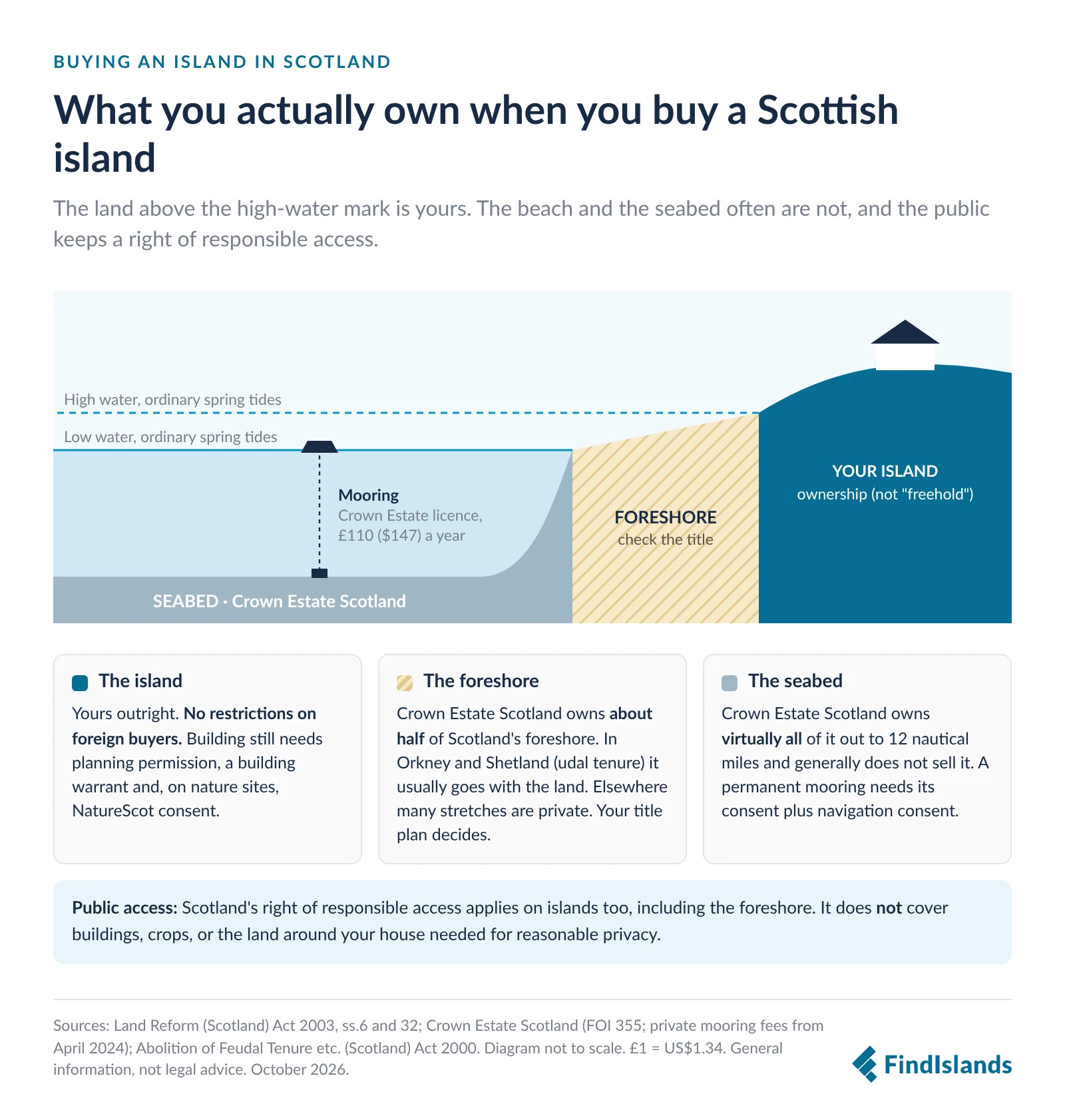
The beach may not come with the island. The strip between high and low tide is called the foreshore. Crown Estate Scotland owns about half of it, and almost all of the seabed. In Orkney and Shetland the foreshore usually goes with the land. Elsewhere, your title plan decides whether your beach, jetty or slipway is yours.
A mooring needs a licence. A permanent mooring needs consent from the seabed owner, which is almost always Crown Estate Scotland. Its private mooring fee is £110 (US$147) a year.
People can still land. Scotland’s right of responsible access covers islands too. It does not cover buildings, crops, or the area around your house that you need for privacy. In practice few people kayak to a remote island, but you cannot ban everyone from the whole island.
Community right to buy
Local communities in Scotland have legal rights to buy land, and these can affect an island sale.
- First refusal: if a community group has registered an interest in the land, it gets the first chance to buy when the owner sells. Check the register of community interests before you make an offer.
- Buying without a willing seller: in some cases, with government consent, a community can buy land even if the owner does not want to sell.
The best-known island buyouts are Eigg in 1997 (£1.5 million, US$2 million) and Ulva in 2018 (valued at £4.65 million, US$6.2 million).
New rules are coming but are not in force yet. The Land Reform (Scotland) Act 2025 will cover very large holdings of more than 1,000 hectares (about 2,470 acres). Sellers will have to tell communities before selling, and the land may have to be sold in lots. Most islands for sale are far smaller. But an island sold together with a mainland estate can cross the limit.
Crofts on islands
Many islands in the Hebrides and Shetland include crofts. A croft is a small farm with special legal protection.
- If the island has tenant crofters, you become their landlord. They keep their tenancy and have the right to buy their crofts from you.
- If you take on a croft yourself, you must normally live within 32 km (20 miles) of it and actually use it, for example for farming.
Either way, croft land is hard to combine with a private holiday island.
Building on a Scottish island
You need planning permission for new buildings, and a building warrant before you build or extend. Historic buildings also need listed building consent.
Many islands are protected nature sites. On these, you need approval from NatureScot before doing anything on the site’s list of restricted works. Large parts of the west coast are also protected for their scenery.
Before you offer on an island without a house, ask the council’s planning department whether a home would be allowed. An island that already has planning consent, like Inchconnachan, costs more for this reason. Check when the consent expires.
What it is like to own an island in Scotland
- Getting there: almost always by boat. Some Solway and Argyll islands are tidal and can be reached on foot at low tide. Tidal crossings can be dangerous, so learn the tide times.
- Seasons: the best months are May to September, with long daylight in summer. Winters are short, dark and wet.
- Weather: strong winds and storms can stop boat crossings for days, especially in the Hebrides and Shetland. Plan for supplies and for being cut off.
- Services: most islands have no mains power or water. Budget for solar or wind power and a water system. Our guides to island energy supply and drinking water on an island explain the options.
Where to buy
- Argyll and the Firth of Lorn: the biggest choice. Sheltered sea lochs, easy boat access, the widest range of prices.
- Loch Lomond: freshwater islands within an hour of Glasgow. High prices and national park planning rules.
- Outer Hebrides and Shetland: large and cheap per acre, but exposed and remote.
- Summer Isles and the north-west Highlands: small islands off Achiltibuie and Ullapool.
- Solway coast: tidal islands you can walk to at low tide.
How to buy an island in Scotland
Buying in Scotland works differently from England. In short:
- Hire a Scottish solicitor early, ideally one who has dealt with rural land or islands.
- Register your interest with the agent, so you hear if a closing date is set.
- Do your checks before you offer. Once an offer is accepted, the deal can become binding within days.
- Make a formal offer. Islands are usually sold as “offers over” a price, with a closing date. The seller does not have to take the highest offer.
- Conclude the contract. Once the solicitors agree the terms in writing, you cannot pull out without penalty.
- Pay, pay the tax and register the island in your name.
Some islands are sold at auction. An auction sale is binding when the hammer falls, so finish all checks before you bid.
Costs of buying and owning
Land and Buildings Transaction Tax (LBTT) is Scotland’s version of stamp duty. The rate depends on whether the island has a building you could live in.
| Price band | Residential | Non-residential |
|---|---|---|
| Up to £145,000 ($194k) / £150,000 ($201k) | 0% | 0% |
| Up to £250,000 ($335k) | 2% | 1% |
| Up to £325,000 ($436k) | 5% | 5% |
| Up to £750,000 ($1.0m) | 10% | 5% |
| Over £750,000 ($1.0m) | 12% | 5% |
| Second home | +8% of the whole price | — |
An empty island is non-residential. But any building you could live in, even a cabin or bothy that needs repairs, makes the island residential. Only a roofless ruin is unlikely to count. The 8% second-home charge applies if you will own two or more homes anywhere in the world. Companies always pay it.
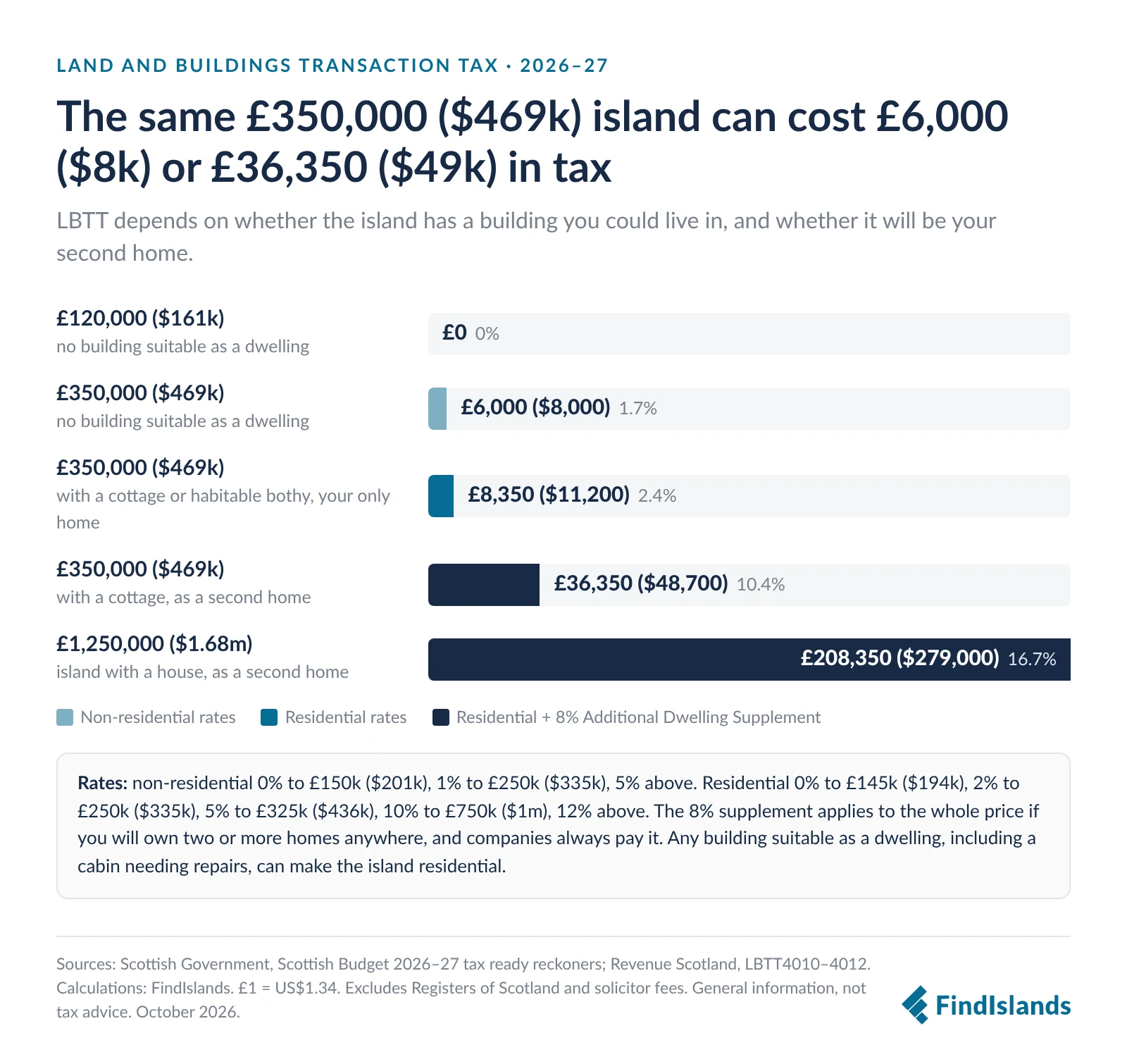
Examples (our calculation, 2026–27 rates):
| Purchase | LBTT |
|---|---|
| £120,000 ($161k) empty island | £0 |
| £350,000 ($469k) island, no building you could live in | £6,000 ($8,000) |
| £350,000 ($469k) island with a cottage, your only home | £8,350 ($11,200) |
| £350,000 ($469k) island with a cottage, second home | £36,350 ($48,700) |
| £1.25m ($1.68m) island with a house, second home | £208,350 ($279,000) |
Other purchase costs:
- Registration fee: for example £660 (US$880) for a £300,000–£500,000 island.
- Solicitor: roughly £2,500–£10,000 (US$3,350–13,400) plus VAT, depending on the price. More for a complicated title.
- Survey: many island homes are holiday homes, which are exempt from the seller’s Home Report. You will usually need your own survey.
Running costs: council tax on any house (councils can double it on second homes), a boat and mooring, insurance, off-grid power and water, and repairs to jetties and slipways. Published figures are rare, so get quotes for your island.
Risks and what to check
- Title: the whole island, the foreshore and any jetty or slipway are in the title.
- Community interests: no registered community interest and no live community buyout.
- Crofts: is any part croft land, and are there tenant crofters?
- Protected status: nature sites, national park, listed buildings.
- Planning: can you realistically build or extend? Does any consent expire soon?
- Access: landing points at all tides, distance to a mainland slipway, winter weather.
- Services: water, power, phone and internet signal.
- Lighthouses: lights are often kept by the Northern Lighthouse Board and are not included.
A Scottish solicitor who knows rural land should check all of this before you make an offer.
Frequently Asked Questions
From about £50,000 (US$67,000) for a small tidal islet to over £6 million (US$8 million) for an estate island with houses. Most uninhabited islands in 2023–2026 asked £120,000–£500,000 (US$160,000–670,000).
Recently, Eilean a’ Chapuill in Knapdale at offers over £50,000 (US$67,000), then Gasker off Harris at offers over £120,000 (US$161,000). Cheap islands are usually small, empty and protected, with no consent to build.
Yes, if there is a house or you get permission to build one. Many islands under £500,000 (US$670,000) have neither, and nature rules can block new homes.
Not always. Crown Estate Scotland owns about half of the foreshore, but almost none in Orkney and Shetland. Check the title plan.
Yes, with no special permission. A non-UK company must register on the Register of Overseas Entities first.
No. Buying property does not give a UK visa, residency or citizenship.
Yes, under Scotland’s right of responsible access. The main exceptions are buildings, crops and the private area around your house.
Scotland has LBTT instead. On an island with no building you could live in, it is £0 up to £150,000 (US$201,000). A house bought as a second home adds 8%.
About 900. Fewer than 100 have people living on them.
Related guides
Prices are asking prices unless marked sold, not valuations. This guide is general information, not legal or tax advice.
Sources
- https://www.landcommission.gov.scot/downloads/5dd6c67b34c9e_Land-ownership-restrictions-FINAL-March-2018.pdf
- https://www.crownestatescotland.com/news/foi-355seabed-and-foreshore-ownership
- https://www.legislation.gov.uk/asp/2003/2/section/6
- https://www.gov.scot/publications/community-rights-to-buy-overview/
- https://brodies.com/insights/rural-business-and-natural-capital/update-on-implementation-of-the-land-reform-scotland-act-2025/
- https://www.crofting.scotland.gov.uk/?p=154968
- https://www.gov.scot/publications/scottish-budget-2026-2027-scottish-tax-ready-reckoners/pages/4/
- https://revenue.scot/taxes/land-buildings-transaction-tax/lbtt-legislation-guidance/residentialnon-residential-technical-guidance/lbtt4010-residential-transactions