Private Islands for Sale in Canada
Table of contents
- Short answer
- Islands for sale in Canada right now
- How much does a private island cost in Canada?
- Can foreigners buy an island in Canada?
- Who owns the shore and the water?
- Where are the private islands in Canada?
- Seasons, access and natural risks
- Costs of buying and owning an island in Canada
- How to buy an island in Canada: step by step
- Risks and what to check
- Frequently Asked Questions
- Sources
Short answer
Yes, you can buy a private island in Canada, and foreigners can own one outright. Canada has tens of thousands of islands in lakes, rivers and on three coasts. Most private islands for sale are in Ontario, British Columbia and Nova Scotia.
As of November 2026, small raw islands start at about C$115,000 (US$82,000). Islands with a cottage on an Ontario lake usually cost C$1–5 million (US$0.7–3.5 million). Large islands with homes on the BC coast reach C$15 million (US$10.6 million) and more.
Foreign buyers pay extra in some provinces: 25% in Ontario on an island with a cottage, 20% in parts of BC and 10% in Nova Scotia. Owning an island does not give you residency.
Islands for sale in Canada right now
We have no Canadian islands for sale on FindIslands right now, so below you will see islands elsewhere in North America. You can also see islands tagged Canada, including sold ones, or browse all islands for sale.
More islands for sale in North America

Selling an island in Canada? List it on FindIslands →
How much does a private island cost in Canada?
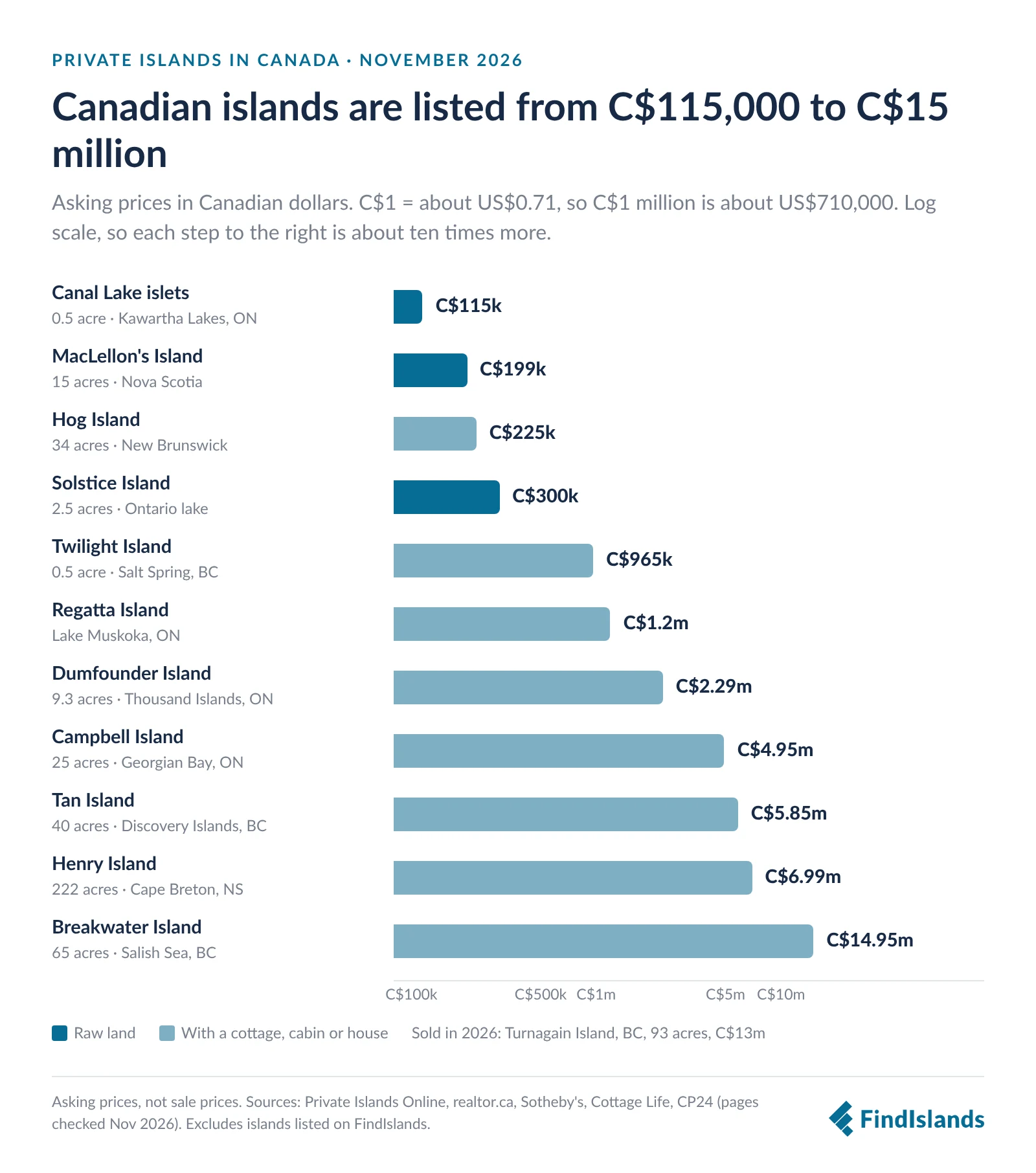
Prices are in Canadian dollars (C$). C$1 is about US$0.71. These are other listings on the market that we checked, as of November 2026.
| Island | Province and area | Size | Asking price | What you get |
|---|---|---|---|---|
| Canal Lake islets | Ontario, Kawartha Lakes | 0.5 acre | C$114,900 (US$82,000) | Three small raw islets |
| MacLellon’s Island | Nova Scotia, Chezzetcook Inlet | 15 acres | C$199,000 (US$141,000) | Raw |
| Hog Island | New Brunswick, Bocabec | 34 acres | C$225,000 (US$160,000) | Two islands, rustic cabin |
| Solstice Island | Ontario, Lake Manitouwabing | 2.5 acres | C$299,900 (US$213,000) | Raw |
| Twilight Island | BC, Ganges Harbour, Salt Spring | 0.5 acre | C$965,000 (US$685,000) | Small home and dock |
| Regatta Island | Ontario, Lake Muskoka | Not stated | C$1,195,000 (US$848,000) | Furnished cottage and boat |
| Dumfounder Island | Ontario, Thousand Islands | 9.3 acres | C$2,290,400 (US$1.63 million) | Main cottage and three more buildings |
| Campbell Island | Ontario, Georgian Bay | 25 acres | C$4,950,000 (US$3.51 million) | Cottage compound |
| Tan Island | BC, Discovery Islands | 40 acres | C$5,850,000 (US$4.15 million) | Two log homes and three cabins |
| Henry Island | Nova Scotia, off Cape Breton | 222 acres | C$6,990,000 (US$4.96 million) | Keeper’s house and lighthouse |
| Breakwater Island | BC, near Gabriola | 65 acres | C$14,950,000 (US$10.6 million) | Log home and deep-water dock |
Sources: Private Islands Online, realtor.ca, Sotheby’s, Cottage Life and CP24 (pages checked November 2026). Prices are asking prices and change often.
What this means for a buyer:
- Raw islands are cheap. Small islands with no buildings in Ontario, Nova Scotia and New Brunswick start under C$300,000 (US$213,000).
- A cottage changes the price. Islands with a usable cottage on a popular lake rarely cost less than C$1 million (US$710,000).
- Location matters most. Muskoka and the BC Gulf Islands are the priciest areas. Nova Scotia and northern Ontario are the cheapest.
- Big sales happen. Turnagain Island, a 93-acre island on BC’s Sunshine Coast, sold in 2026 for C$13 million (US$9.2 million). An island on Lake Joseph in Muskoka was listed in 2023 at C$32.5 million (US$23 million).
What is the cheapest private island in Canada?
The cheapest island we found in November 2026 was a group of three tiny islets on Canal Lake in Ontario’s Kawartha Lakes, listed at C$114,900 (US$82,000). The cheapest larger island was MacLellon’s Island in Nova Scotia: 15 acres for C$199,000 (US$141,000).
Can foreigners buy an island in Canada?
Yes. There is no general rule against foreigners owning land in Canada. Most islands for sale are freehold: you own the land outright, with no end date.
Three things can change this.
- The federal ban on homes. Since 2023, non-Canadians cannot buy homes in and around cities and larger towns. Many cottage areas are outside these zones, and vacant land is not covered, but some lake areas are inside them. Your lawyer can check the exact location. The ban runs until 1 January 2027. As of November 2026, the government has not said whether it will extend it.
- Extra taxes in some provinces. Ontario charges foreign buyers 25% on a home or cottage. BC charges 20% around Vancouver, Victoria and Nanaimo, which includes Salt Spring and the Southern Gulf Islands. Nova Scotia charges non-residents 10%.
- Limits on land in a few provinces. In Prince Edward Island, non-residents need approval to own more than 5 acres or 165 feet of shore.
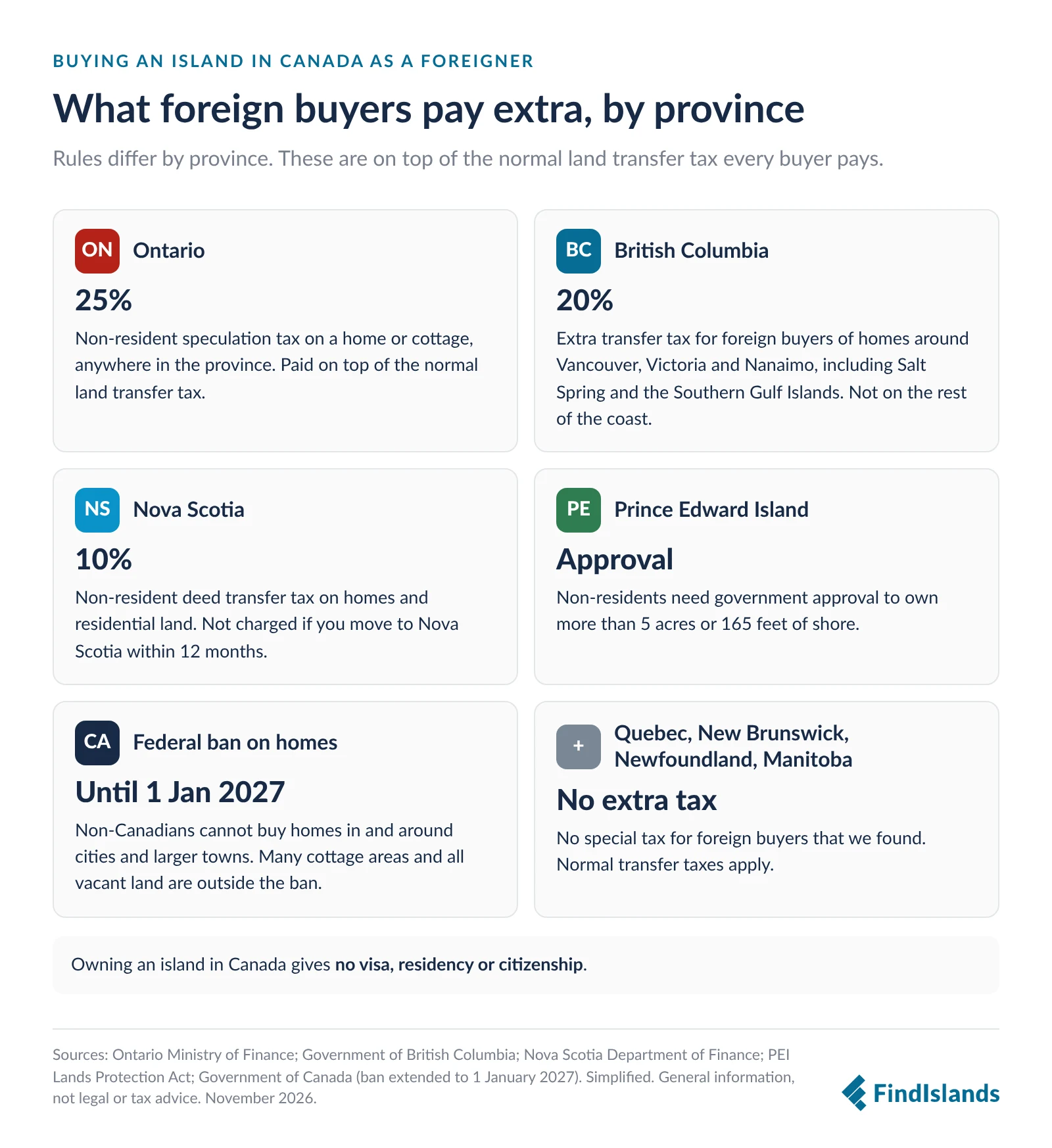
Owning an island does not give you residency, a visa or citizenship in Canada. You can usually visit as a tourist for up to six months at a time. Immigration is a separate process with its own rules.
Who owns the shore and the water?
In Canada, most land still belongs to the government. This is called Crown land. Around islands, it matters in three places.
- The lake or sea bed. It usually belongs to the province. In BC, the shore between high and low tide belongs to the province too, and the public may walk on it.
- Docks. A small private dock is usually allowed under general rules. Bigger docks, boathouses or work on the shore may need a permit.
- The strip along the shore. In Ontario, some waterfront land has a 66-foot strip along the water that belongs to the town or the Crown. Owners can often buy it. Ask your lawyer whether the island has one.
Some islands are also inside parks, conservation areas or First Nations land. You cannot buy these, and land near them may have extra rules.
Where are the private islands in Canada?
- Ontario: the biggest market. Muskoka, Georgian Bay and the Thousand Islands are popular and expensive. Lake of the Woods, the Kawarthas and northern lakes are cheaper. Most islands are summer cottages.
- British Columbia: the Gulf Islands, the Sunshine Coast and the Discovery Islands. Mild winters, ocean views and high prices.
- Nova Scotia: many islands along the Atlantic coast and in Mahone Bay. Prices are lower, and the market attracts many European buyers.
- Quebec, New Brunswick and Newfoundland: fewer listings, often large and raw. In Quebec, a notary (notaire) handles the purchase.
See more islands across the region in North America, or compare with our guide to private islands for sale in the United States.
Seasons, access and natural risks
- Summer use: most lake islands in Ontario and Quebec are used from May to October.
- Ice: lakes freeze from about December to April. In autumn and spring there are weeks when you cannot reach the island by boat or on the ice.
- The coasts: in BC you can reach islands by boat all year, but winter storms are strong. Atlantic islands get fog and the remains of hurricanes. Storm Fiona hit Atlantic Canada hard in 2022.
- Wildfires: a growing summer risk in BC and northern Ontario.
- Getting there: most islands are a short boat ride from a marina. Remote ones need a floatplane.
Most islands have no grid power or town water. Our guides to island energy supply and drinking water on a private island explain the options.
Costs of buying and owning an island in Canada
| Cost | Typical amount | Notes |
|---|---|---|
| Land transfer tax | About 1–3% | Ontario 0.5–2.5%, BC 1–3% (more on homes over C$3 million). Nova Scotia towns charge up to 1.5% |
| Extra tax for foreign buyers | 0–25% | See the province rules above |
| Lawyer or notary | C$2,000–5,000 (US$1,400–3,500) | More for complex titles |
| Survey and inspections | C$2,000–10,000 (US$1,400–7,100) | Water, septic and dock checks |
| Agent’s commission | Usually paid by the seller | — |
Every year you pay property tax to the town or the province, plus insurance, a boat, a marina spot, fuel and upkeep of the dock, power and water. Insurance on water-access property can be hard to get and costs more. In BC, the yearly speculation and vacancy tax does not apply to islands reached only by boat or plane (Vancouver Island is the exception).
Financing: many banks will not lend on an island, or ask for a large deposit. Many buyers pay cash.
How to buy an island in Canada: step by step
- Hire a local lawyer (or a notary in Quebec) before you sign anything.
- Check the province rules for foreign buyers and what you will pay in tax.
- Check the title: freehold or Crown lease, the survey, and any shore strip or right of way.
- Check the land: zoning, building rules, septic approval and whether you can build a dock.
- Visit in both seasons if you can, to see access in spring and autumn.
- Sign the offer with conditions for inspection, survey and financing.
- Close the sale and register the title through your lawyer.
If you are offered a lease instead of full ownership, read our guide to freehold vs leasehold islands.
Risks and what to check
- Foreign buyer taxes: in Ontario, 25% can add more to the cost than anything else.
- Crown land: the dock, the shore strip or part of the island may belong to the government.
- Building rules: many lakes limit new cottages, septic systems and tree cutting near the water.
- Access: check the boat route, the marina and the ice season.
- Size and price claims: a listing may sell only part of an island. Check the survey.
A Canadian real estate lawyer should check the title, the survey and the tax before you sign anything.
Frequently Asked Questions
Yes. Many islands in Canada are privately owned, and foreigners can buy them. Some provinces charge foreign buyers extra tax.
As of November 2026, asking prices ran from about C$115,000 (US$82,000) for small raw islets to C$15 million (US$10.6 million) for large islands with homes in BC.
The cheapest we found in November 2026 were three small islets on Canal Lake, Ontario, listed at C$114,900 (US$82,000).
Yes. The federal ban on homes covers only areas in and around cities and larger towns, and it runs until 1 January 2027. Americans pay the same foreign buyer taxes as other non-residents, such as 25% on a cottage in Ontario.
In Ontario, especially Muskoka, Georgian Bay and the Thousand Islands, then on the BC coast and in Nova Scotia.
It depends on the province: 25% in Ontario on a home, 20% in parts of BC and 10% in Nova Scotia. We found no special foreign buyer tax in Quebec, New Brunswick or Newfoundland.
No. Owning property in Canada gives no visa, residency or citizenship.
Lake islands in Ontario and Quebec are mostly used from May to October. Islands on the BC coast can be used all year.
Prices are asking prices unless marked sold, not valuations. This guide is general information, not legal or tax advice.
Sources
- https://www.airdberlis.com/insights/publications/publication/federal-government-extends-prohibition-on-purchase-of-residential-property-by-non-canadians-to-january-1-2027
- https://www.ontario.ca/document/non-resident-speculation-tax
- https://www2.gov.bc.ca/gov/content/taxes/property-taxes/property-transfer-tax/additional-property-transfer-tax
- https://www.novascotia.ca/non-resident-provincial-deed-transfer-tax
- https://www.ontario.ca/page/road-allowances-dedicated-roads-and-crown-shoreline-reserves-disposition-policy
- https://www2.gov.bc.ca/gov/content/industry/crown-land-water/crown-land/crown-land-uses/residential-uses/private-moorage
- https://www.cp24.com/news/canada/2026/08/06/this-private-island-in-bc-just-sold-for-13m/
- https://www.privateislandsonline.com/region/canada