Private Islands for Sale in the United States
Table of contents
- Short answer
- Islands for sale in the US right now
- How much does a private island cost in the US?
- Can foreigners buy a private island in the US?
- Where are the private islands in the US?
- Who owns the shore of a US island?
- What can you build on a US island?
- Seasons, access and natural risks
- Costs of buying and owning a US island
- How to buy a private island in the US: step by step
- Risks and what to check
- Frequently Asked Questions
- Sources
Short answer
Yes, you can buy a private island in the United States, and there is no national ban on foreign buyers. The US has thousands of private islands, most of them on lakes, rivers and the northern coasts.
Prices start under $500,000 for a small Maine island with a cabin. Lake islands with a good house cost about $1.5–3 million. Large coastal islands and Florida trophy islands run from $7 million to $75 million and more.
Rules differ a lot from state to state. Check three things before you buy: who owns the shore, what you are allowed to build, and how you reach the island in every season.
Islands for sale in the US right now
These are the US islands currently listed on FindIslands. You can also browse all islands for sale or see every listing tagged United States.

Selling an island in the US? List it on FindIslands →
How much does a private island cost in the US?
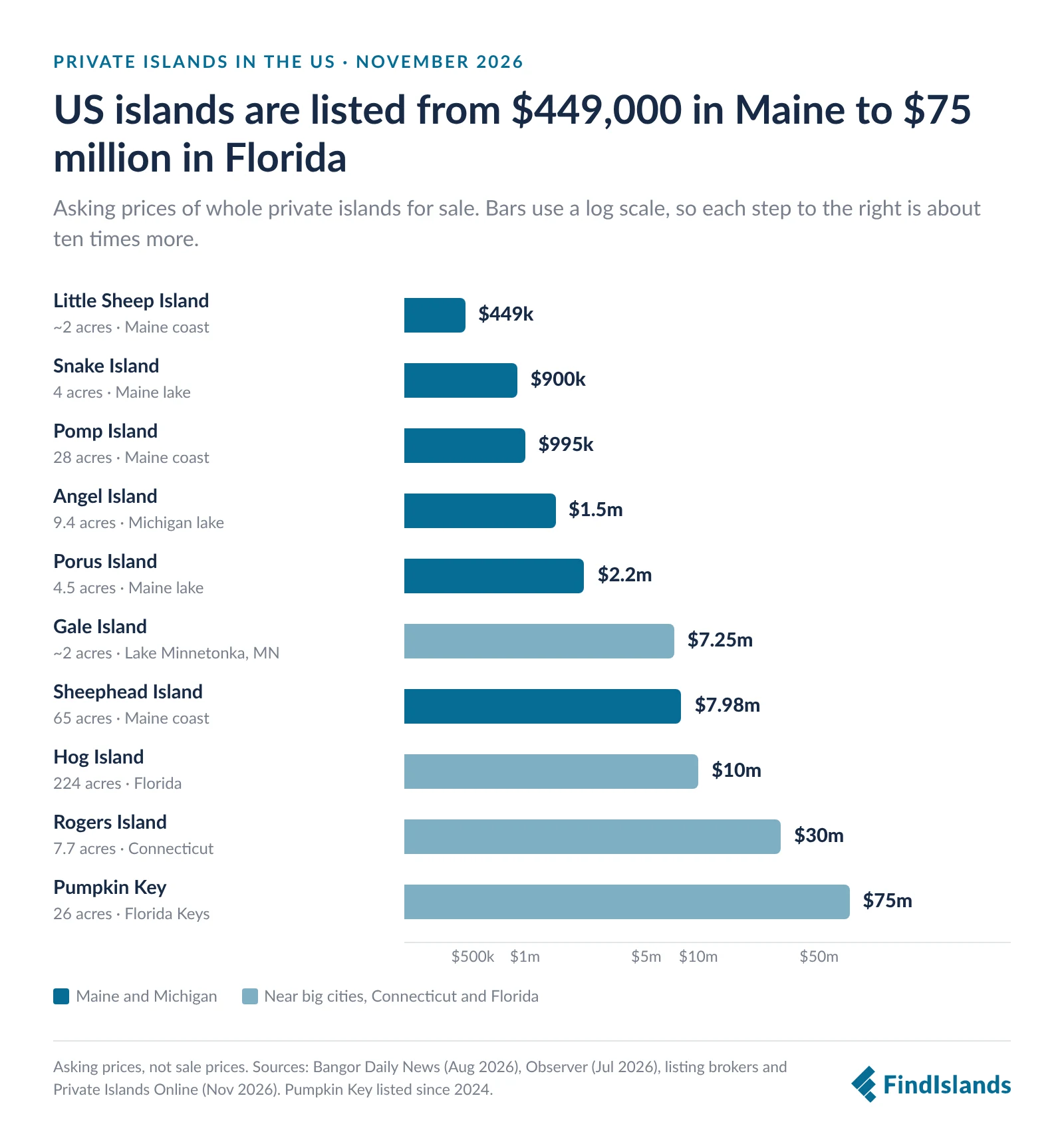
There is no public database of island sales. The best guide is what sellers are asking now. These are listings we checked, as of November 2026.
| Island | State | Size | Asking price | What you get |
|---|---|---|---|---|
| Little Sheep Island, Jonesport | Maine (coast) | ~2 acres | $449,000 | 1-bedroom cabin |
| Snake Island, Beaver Cove | Maine (lake) | 4 acres | $900,000 | Camp and guest cottage |
| Pomp Island, Beals | Maine (coast) | 28 acres | $995,000 | 3-bedroom log cabin |
| Angel Island, Sixteen Mile Lake | Michigan | 9.4 acres | $1,495,000 | 4-bedroom chalet, mainland lot |
| Porus Island, Pemadumcook Lake | Maine (lake) | 4.5 acres | $2,200,000 | 4-bedroom cabin |
| Gale Island, Lake Minnetonka | Minnesota | ~2 acres | $7,250,000 | Main house, guest house, historic house |
| Sheephead Island, Deer Isle | Maine (coast) | 65 acres | $7,975,000 | Reachable by car at low tide |
| Hog Island | Florida | 224 acres | $10,000,000 | Land |
| Rogers Island, Branford | Connecticut | 7.7 acres | $29,995,000 | 10-bedroom Tudor house |
| Pumpkin Key, near Key Largo | Florida | 26 acres | $75,000,000 | Main house, marina, staff housing |
Sources: Bangor Daily News (August 2026), the listing brokers and Private Islands Online (November 2026). Pumpkin Key has been listed since 2024.
What this means for a buyer:
- The cheapest islands are in Maine and on northern lakes. A small island with a basic cabin can cost less than a house in a big city.
- The house matters more than the acres. A 2-acre island near Minneapolis costs more than a 65-acre island in Maine.
- Raw land can be very cheap per acre. An 800-acre bay island in Texas was listed at about $800,000 in 2026, with no house.
- The top end is set by Florida. Tarpon Island in Palm Beach, about 2.3 acres, sold for a reported $152 million in May 2024.
What is the cheapest private island in the US?
The cheapest whole island with a house that we found in November 2026 was Little Sheep Island in Maine, at $449,000. Tiny islands with no house sell for even less. Honk’s Island, a rock of under 0.1 acre in Stonington, Maine, sold for $35,000 in February 2025.
Can foreigners buy a private island in the US?
Yes, in most cases. The US has no national law that stops foreigners from buying property. But a few rules can apply.
- State laws. More than 25 states now limit land purchases by people and companies from certain countries, mainly China, Iran, North Korea and Russia. Most of these laws cover farmland or land near military sites. Florida and Texas have the widest rules.
- Farmland reporting. A foreign owner of farm, ranch or forest land must report it to the US Department of Agriculture. This can apply to a large, wooded island.
- Security review. A purchase near a military base, airport or port can be reviewed by the federal government.
- Selling later. When a foreign owner sells, the buyer usually holds back 15% of the price for the tax authority (IRS). Plan for this from the start.
Owning an island does not give you a visa, a green card or citizenship. The only investor green card (EB-5) requires an investment of at least $800,000 in a US business that creates 10 jobs. Buying a home or an island does not count.
Where are the private islands in the US?
- Maine: the biggest choice. The state registry counts more than 3,000 coastal islands, and about 1,800 of them are privately owned. Thousands more sit in its lakes.
- Great Lakes and Michigan: islands in inland lakes and rivers, many in the Upper Peninsula.
- Minnesota and Wisconsin: lake islands, from simple Northwoods camps to estates near Minneapolis.
- Thousand Islands, New York: river islands on the St. Lawrence. Many listings are on the Canadian side, so check the address.
- Florida: the Keys and the Gulf coast. This is the most expensive market.
- Carolinas and Georgia: marsh and sound islands, often sold as land only.
- Pacific Northwest and Alaska: whole islands are rare in the San Juan Islands. In Alaska, islands are remote and reached by boat or floatplane.
Looking further north? See our guide to islands for sale in Canada.
Who owns the shore of a US island?
When you buy an island, you may not own the beach. Each state draws the line in its own place.
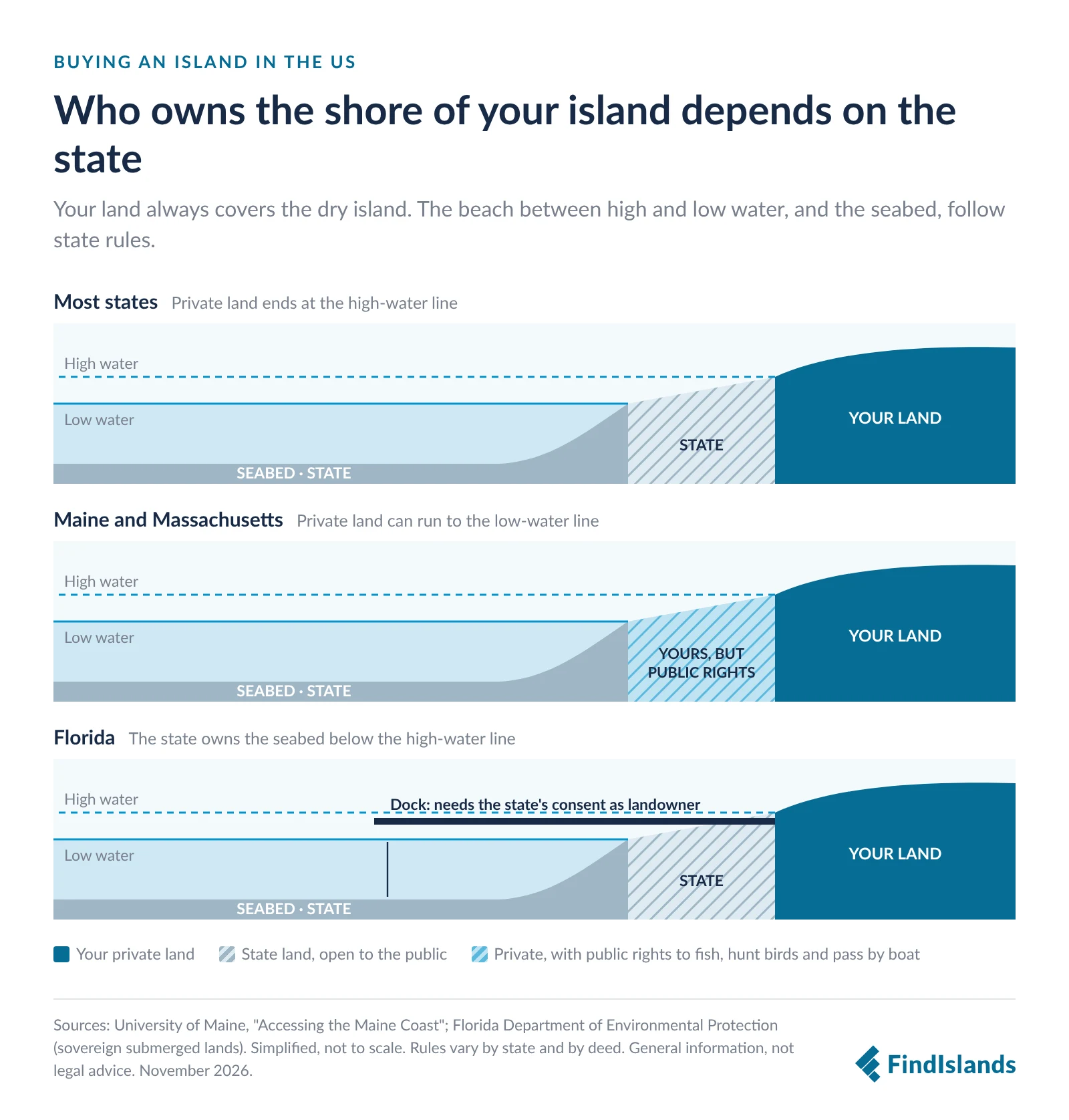
- Most states: your land stops at the high-water line. The state owns the land below it for public use.
- Maine and Massachusetts: you can own down to the low-water line. The public can still fish, hunt birds and pass by boat there.
- Florida: the state owns the seabed below the high-water line. A dock may need the state’s consent as landowner, not just a permit.
- Maine’s island registry: every coastal island had to be registered by 1975. Ask the seller for proof of registration.
What can you build on a US island?
Building rules are local, and on islands they are often strict.
- Setbacks from the water. In Maine, new buildings usually must stand 75 feet back from the shore, or 100 feet from great ponds. On a small island, this can rule out a new house.
- Florida beaches. Building near a sandy beach needs a special coastal permit from the state.
- Docks. Most docks need a permit from the US Army Corps of Engineers and from the state.
- Septic and water. Rocky islands often fail the soil test for a normal septic system. Ask the county before you buy.
- Flood zones. Many islands sit in flood zones on federal (FEMA) maps. A mortgage then requires flood insurance.
An island that already has legal buildings and a dock is often worth more than one that needs every permit from scratch.
Seasons, access and natural risks
- Hurricanes: the Atlantic and Gulf season runs from June to November and peaks in September. This affects Florida, the Gulf coast and the Carolinas most.
- Winter storms: nor’easters hit New England and the Mid-Atlantic coast in winter.
- Ice on northern lakes: in the Great Lakes region, ice forms from late November. During freeze-up and break-up, you cannot use a boat and the ice is not safe to cross.
- Summer-only islands: most islands in Maine, Michigan, Minnesota and the Thousand Islands are used from about May to October.
- Rising sea levels: US coasts are expected to see about a foot of sea level rise by 2050. Low islands will face more erosion and flooding.
You also need a way to reach the island: usually a boat, a dock and a parking spot on the mainland. Good listings include a mainland lot. If not, budget for one.
Costs of buying and owning a US island
When you buy, expect closing costs of about 1–3% of the price, plus survey and inspection costs that are higher on an island. Some states also charge a transfer tax:
| State | Transfer tax | On a $2 million island |
|---|---|---|
| Maine | 0.44% up to $1 million, 1.2% above | $16,400, usually split between buyer and seller |
| Florida | 0.70% on the deed | $14,000 |
| Washington | 1.1% to 3%, rising with the price, plus a local tax | About $31,600 plus the local tax |
| Texas | None | $0 |
Every year, plan for:
- Property tax: set by the county or town. It ranges from about 0.3% to 2.4% of the value a year, depending on the state.
- Insurance, including flood or hurricane cover where needed.
- A boat, the dock and mainland parking.
- Power: many islands have no grid cable. Our guide to island energy supply compares solar, generators and cables.
- Water: a well, rainwater or a filter system. See our guide to drinking water on a private island.
- A caretaker for the months when the island is empty.
How to buy a private island in the US: step by step
- Pick the state first. Rules on shore ownership, building and taxes differ by state.
- Check the title. Order a title search and title insurance. Make sure the deed covers the whole island and lists any easements.
- Check what you can build. Ask the town or county about setbacks, septic and building permits.
- Check access. Confirm the dock, the mainland parking and any rights of way.
- Check the flood zone and insurance cost before you make an offer.
- Sign a purchase agreement with conditions for title, survey and permits.
- Close the sale through a title company or a lawyer, and record the deed with the county.
Many buyers hold an island through a company (LLC) for privacy. Ask your lawyer if this suits you.
Risks and what to check
- Shore and seabed: check who owns the land below the high-water line, and whether your dock needs state consent.
- Buildings without permits: they can be hard to insure or ordered removed.
- Easements: conservation easements or public rights can limit what you build.
- State rules on foreign buyers: check the law in that state before you sign.
- Winter access: visit outside summer, or ask how the island is reached in winter.
- Insurance: get a quote early. On hurricane coasts it can be a large yearly cost.
A local real estate lawyer should check the title, the shore rights and the building rules before you sign anything.
If you are also looking at the Caribbean, compare with our guide to private islands for sale in the Bahamas.
Frequently Asked Questions
Yes. Thousands of US islands are privately owned, and many come up for sale every year, mostly in Maine, the Great Lakes region, Minnesota and Florida.
As of November 2026, asking prices ran from about $450,000 for a small Maine island with a cabin to $75 million for Pumpkin Key in Florida. Most lake islands with a good house cost $1.5–3 million.
The cheapest island with a house we found in November 2026 was Little Sheep Island, Maine, at $449,000. Tiny rocks with no house have sold for less than $50,000.
Yes, in most states. Some states limit purchases by buyers from China, Iran, North Korea and Russia, mainly for farmland or land near military sites.
No. Owning property gives no visa or residency. The EB-5 investor visa requires an investment in a US business that creates jobs, not a home.
Usually only down to the high-water line. In Maine and Massachusetts it can go down to the low-water line, but the public keeps rights to fish and pass by boat.
Maine. Its coastal island registry lists about 1,800 private islands, and there are many more on its lakes.
Sometimes. Northern lake and coastal islands are often cut off by ice or storms in winter. Florida islands can be used all year, but hurricane season runs from June to November.
Prices are asking prices unless marked sold, not valuations. This guide is general information, not legal or tax advice.
Sources
- https://www.maine.gov/DACF/parks/about/coastal_island_registry.shtml
- https://www.law.cornell.edu/regulations/maine/06-096-C-M-R-ch-1000-SS-15
- https://floridadep.gov/water/submerged-lands-environmental-resources-coordination/content/sovereign-submerged-lands-ssl
- https://www.irs.gov/individuals/international-taxpayers/firpta-withholding
- https://www.uscis.gov/working-in-the-united-states/permanent-workers/eb-5-immigrant-investor-program
- https://www.mintz.com/insights-center/viewpoints/2896/2026-01-28-increasing-regulation-foreign-ownership-united-states
- https://www.nhc.noaa.gov/climo/index.php
- https://www.bangordailynews.com/2026/08/24/business/3-maine-private-islands-for-sale-under-one-million-joam40zk0w/